
Historical Continuity of Nelson’s Agenda
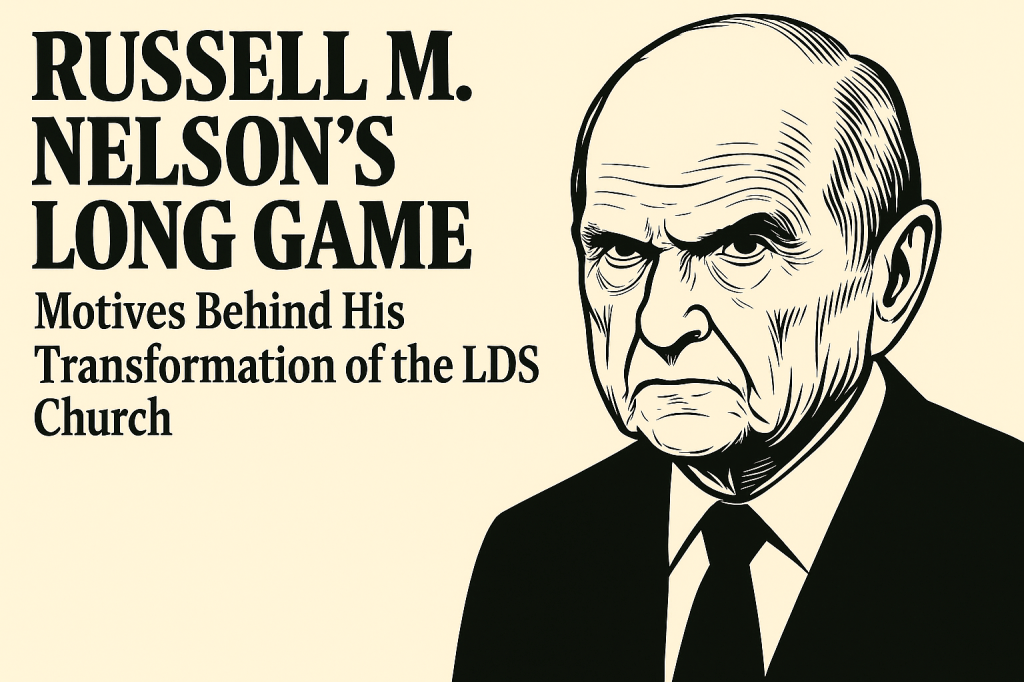
From the moment Russell M. Nelson assumed the presidency of the Church of Jesus Christ of Latter-day Saints (LDS) in January 2018, he began implementing changes that closely mirror personal priorities he had voiced as far back as the 1980s. A prime example is Nelson’s crusade against the word “Mormon.” As a junior apostle in April 1990, Nelson gave a conference talk titled “Thus Shall My Church Be Called,” arguing that only the full divine name of the Church should be used. At the time his stance was couched as a polite suggestion, acknowledging that the nickname “Mormon” “may” offend Jesus. But senior leaders like President Gordon B. Hinckley gently downplayed Nelson’s concerns later that year. Fast-forward 28 years: now-President Nelson revisited this exact issue with renewed intensity, declaring in 2018 that using any nickname for the Church was “a major victory for Satan,” elevating his old pet peeve into what he calls “the command of the Lord.” The consistency of Nelson’s position over decades – and the stark escalation in tone – reveal how a long-held personal agenda was finally enforced from the top. As religion commentator Jana Riess observed, “then-Elder Nelson made many of the same points he reiterated more forcefully” once he had the highest office. The only difference was that now he had the authority to mandate the change rather than merely propose it.
Nelson’s presidency has similarly been marked by the fulfillment of other initiatives he had been “concerned about but could never do” until he gained ultimate authority. His own wife, Wendy Watson Nelson, candidly noted the transformation: “It is as though he’s been unleashed. He’s free to finally do what he came to earth to do … free to follow through with things he’s been concerned about but could never do. Now that he’s president of the Church, he can do those things.” This striking statement, made only months into his tenure, confirms that many of Nelson’s sweeping changes were not sudden revelations in 2018 but rather longstanding preferences held over his 34 years as an LDS apostle. Indeed, many of the institutional reforms rolled out in his first year – from the introduction of a shorter Sunday meeting schedule to the overhaul of temple rituals – had been discussed behind closed doors for years. They languished under previous leadership but were rapidly approved once Nelson could “pull the trigger.” As one analysis noted, “many of the institutional revisions had been discussed and debated for years … but it was Nelson who pulled the trigger” when he took charge. In short, Nelson’s presidency represents not a break with his personal past but a vigorous enforcement of his long-held views, now stamped with the imprimatur of prophetic revelation.
Aggrandizement of the Prophetic Office
Under Nelson’s leadership, the power and persona of the Church President have been amplified to an unprecedented degree. He has centralized decision-making and projected an aura of prophetic certainty around even mundane administrative changes. Nelson speaks in the uncompromising language of command and revelation, often invoking God’s direct authority behind his initiatives. For example, in insisting that members use the Church’s full name, Nelson did not frame it as a mere branding preference – he declared “this is not a name change… It is the command of the Lord,” warning that every use of “Mormon” offends Christ and lets Satan win, despite the fact that the Church spent millions of dollars on the “I’m a Mormon” marketing campaign. By redefining a cosmetic rebrand as a divine mandate, Nelson elevated his personal emphasis on nomenclature to a test of obedience. This pattern – couching policy preferences as God’s will – has the effect of magnifying the president’s pronouncements to near-canonical status. Church members are now told that even minor matters (like terminology) carry the weight of revelation. As one observer noted, the push to drop “Mormon” has become “a litmus test of obedience” among the faithful. It exemplifies how Nelson has aggrandized his office: his words are to be taken not as suggestions or interpretations, but as the unequivocal “will of the Lord.”
Beyond rhetoric, Nelson has made concrete moves to consolidate the President’s role as the single focal point of authority. Early in his tenure, he altered long-standing protocols to tighten the prophet’s control over church proceedings. Notably, the April 2018 General Conference – the first under Nelson – did not follow routine. Nelson reportedly assigned specific topics to apostles, a sharp departure from past practice where each leader prayerfully chose their own theme. This micromanaging of a once-decentralized process sent a clear message that the new president’s agenda would shape all facets of Church discourse. It signaled a top-down management style more common to a CEO than a consensus-driven council of apostles. Indeed, President Dallin H. Oaks and Henry Eyring (Nelson’s counselors) have publicly lauded his “swift decision-making,” suggesting that Nelson’s natural leadership instincts as a former heart surgeon (“quick thinking, confident life-and-death movements”) now guide the Church’s direction. Such praise from his deputies only reinforces the image of a singular great man at the helm.
In Church media and culture, President Nelson is heralded with extraordinary deference – even compared to his predecessors. Anecdotally, long-time members note an uptick in what they term “leader worship” since Nelson took office. There is quantitative evidence of this as well. A data analysis of General Conference speeches from 1942–2021 found that mentions of the current Church President spiked dramatically after Nelson assumed office. For seven decades, LDS speakers consistently mentioned the prophet around 0.5 times per 1,000 words, with little variation. But “something changed in 2018 when Russell Nelson became president,” the analysts note – references to the prophet doubled, surging to over 1.0 mentions per 1,000 words and “an all-time high” frequency. In other words, General Authorities now quote or praise President Nelson in their sermons about twice as much as was normal under previous prophets. This statistical spike suggests a deliberate elevation of Nelson’s status and teachings within the Church’s own rhetoric. The president’s counsel is constantly emphasized, his name invoked as the ultimate spiritual authority to bolster others’ messages. Such dynamics strengthen a culture of obedience centered on the man at the top.
Nelson himself appears comfortable with – even encouraging of – this heightened adulation. LDS headquarters and media productions have in many ways built up the mystique of President Nelson as God’s singular mouthpiece. In the eyes of devout members, he is not just an administrator but a prophet for the ages, “foreordained” before birth to lead the Church in the last days. Sister Wendy Nelson has described her husband in near-messianic terms, testifying that he “reports only to the Lord” and that God has “pour[ed] strength into [President Nelson]” to accomplish mighty tasks now unfolding. Internally, such statements foster an almost infallible image of Nelson – a leader who answers to no earthly check or balance. He is portrayed as “fearless” in executing the Lord’s will, owing accountability only upward, not to the membership or even his fellow apostles. This rhetoric effectively sanctifies Nelson’s personal leadership style. It also sidelines any notion of collective governance by the Quorum of Twelve: while officially the LDS President is “first among equals,” under Nelson the prophetic office has been elevated to a singular, untouchable throne. Critics argue that this centralization has eroded the collaborative spirit of past administrations in favor of one-man rule. Even relatively conservative scholars note how unusual the current dynamic is. Laurie Maffly-Kipp, a religion professor who studies Mormonism, observes that outsiders increasingly see LDS leaders’ moves – such as the abrupt name mandate – as “arbitrary and illogical gesture[s]” that believers accept without question, confirming the stereotype that Mormons “simply ‘follow the prophet’ in all things, no matter how nonsensical”. In Nelson’s era, “following the Prophet” has been intensified to near-total alignment – a cultural shift that concentrates power and prestige in the president’s person.
Moves Toward Protestantization and Mainstreaming
Many of Nelson’s reforms appear aimed at making the LDS Church look, feel, or function more like other mainstream Christian denominations – a trend some have dubbed the “Protestantization” of Mormonism. This involves shedding or downplaying uniquely Mormon identifiers in favor of a more generic, Jesus-focused Christian identity. The push to eradicate the term “Mormon” is emblematic. Nelson’s insistence on the full official name (with its emphasis on “Jesus Christ”) was explicitly framed as correcting an error that “erases ‘all that Jesus Christ did for us’”. In practical terms, it was a rebranding to re-center public perception on Christ. Church websites, choir names, email domains, and signage were all changed to remove colloquial labels (Mormon/LDS) and highlight Jesus. This move surprised observers and even many members, for whom the well-loved nickname “Mormon” had been part of their identity for generations. Nonetheless, Nelson was adamant that the Church distance itself from the term – even disavowing past PR campaigns like “I’m a Mormon,” which he effectively implied were mistaken or misled. In doing so, he charted a more evangelical-style course, where the name of Jesus is front and center. The result has been a noticeable shift in LDS discourse: references to Jesus Christ in official settings have skyrocketed. For example, an analysis of the October 2024 General Conference found that speakers mentioned Jesus Christ on average 47 times per talk – an unusually dense saturation of Christ-centered language. Leaders have been explicitly encouraged to “focus on the Savior” in their messages, especially around Easter. By comparison, prior conferences from a decade or two ago featured only a fraction of those references. This deliberate “Jesus-soaked” rhetoric aligns the LDS tone more closely with Protestant evangelicals, who similarly pepper their preaching with frequent Jesus mentions. Nelson’s strategy seems to be to present Mormonism to the world unabashedly as a Christ-centric, Bible-believing church, distancing it from the “cultish” aura of the Mormon nickname and the folk traditions that accompanied that label.
Nelson has also streamlined or discarded some exotic LDS practices and imagery, further nudging the faith toward a more generic Christianity. Long-running theatrical pageants – once a charming hallmark of Mormon culture, with costumed casts reenacting Book of Mormon stories or pioneer history – have been largely shut down on Nelson’s watch. In 2018, the Church announced that most of its pageants (such as the famous Hill Cumorah Pageant) would be discontinued or radically scaled back. The stated rationale was to “simplify” and eliminate events that drew huge volunteer efforts but had limited missionary payoff. In effect, Nelson phased out a century-old Mormon folk practice that outsiders often saw as quaint, odd, or quasi-theatrical. Ending the pageants signaled a turn away from insular cultural pageantry toward more standardized worship activities that any Christian church might recognize (spiritual devotionals, Christmas concerts, etc.). Likewise, Nelson quietly removed the iconic Angel Moroni statue from new temple designs in several cases. While the Angel Moroni (a Book of Mormon figure who tops many LDS temples) has not been universally eliminated, a number of recently announced temples feature no Moroni statue – a notable break from LDS tradition. Even the flagship Salt Lake Temple, currently under renovation, had its Moroni statue taken down for seismic upgrades and rumors suggest it may not be replaced atop the spire. The absence of Moroni’s golden figure (a distinctly Mormon symbol unfamiliar to other Christians) will make LDS temples look more architecturally akin to generic chapels or churches. An image of the Salt Lake Temple, long crowned by the Angel Moroni statue. Nelson’s administration appears comfortable de-emphasizing such uniquely Mormon markers in favor of a lower profile. Removing Moroni, like dropping the “Mormon” name, aligns with presenting the Church as an orthodox Christian body rather than a peculiar people with their own icons and lingo.
Some of Nelson’s other policy changes also echo trends in broader Christianity, especially American evangelicalism. For instance, the Sunday worship schedule was cut from three hours to two in late 2018, reframing the remaining meetings as part of a “home-centered, church-supported” Sabbath experience. The cumbersome three-hour block (unique to LDS practice since the 1980s) was replaced by a more typical-length service, akin to many Protestant Sunday services that last about 1–2 hours. This change was greeted with relief by members and may have been inspired in part by a recognition that modern families (including converts) are more accustomed to shorter church engagements – a nod to mainstream norms. The extra hour is now meant for home scripture study (using a new “Come, Follow Me” curriculum), emphasizing personal and family devotion in a way not unlike evangelical home Bible studies. The shift encourages members to take charge of their own gospel learning, with the Church providing materials and support – a concept very much in harmony with Protestant ideals of individual scripture study and the priesthood of all believers.
Nelson’s era has also seen a greater engagement with the broader Christian world. In 2019, he became the first LDS prophet to meet with a sitting Pope (Pope Francis) at the Vatican, a highly symbolic gesture of goodwill. He has strengthened interfaith ties, such as forging an alliance with the NAACP for humanitarian and educational initiatives, and has repeatedly stressed points of common ground with traditional Christianity (e.g. promoting Jesus-centric Easter celebrations and issuing a new proclamation on the Restoration that highlights Jesus Christ as head of the Church). These moves project an image of the LDS Church as simply another Christian denomination – one that is eager to be seen as part of the global Christian community rather than a heterodox sect. Indeed, to many evangelical Christians, Nelson’s reforms make Mormonism appear less alien: greater focus on Jesus, less emphasis on Joseph Smith or unique terminology, and a softening of stringent practices. (For example, in 2019 the Church reversed a policy that had prohibited children of same-sex couples from baptism, an about-face that some saw as making LDS policy slightly less hardline than before. The change doesn’t equal full acceptance of LGBTQ relationships, but it removed a particularly harsh rule that many other churches never had in the first place.) Collectively, these adjustments under Nelson nudge the LDS institution toward the mainstream currents of contemporary Christianity – especially in the United States, where church growth has stalled and an image makeover was arguably overdue. Of course, the LDS Church still retains fundamental differences in theology (priesthood authority, additional scriptures, temple ordinances, etc.), but outwardly it is inching closer to what an outsider might expect from a traditional Christian church: a lot of talk of Jesus, simplified worship services, less secretive imagery, and friendly engagement with other faith leaders. Nelson, a pragmatic 98-year-old, seems determined to recast the faith in a more globally palatable, Protestant-friendly light, even as he doubles down on core doctrines internally.
Notable Doctrinal and Policy Changes Under Nelson
Nelson’s presidency has been marked by a torrent of changes – so many that members jokingly talk of taking “vitamin pills” to keep up. In just a few years, he has introduced or accelerated shifts in doctrine, policy, and practice that touch nearly every aspect of LDS life. Some changes constitute outright doctrinal re-emphasis or de-emphasis, while others are administrative or cultural. Together they amount to one of the most dynamic periods of reform in Church history (comparable perhaps only to the early pioneer era). A non-exhaustive list of major changes and initiatives under Nelson includes:
- Rebranding the Church’s name: Nelson directed members to use the full name “The Church of Jesus Christ of Latter-day Saints” exclusively, abandoning all shorthand (“LDS,” “Mormon Church,” etc.). He framed this as doctrinally important, stating it was revelation from God to “correct” the name and honor Jesus Christ. The longstanding nickname “Mormon,” once embraced even by Church campaigns, is now effectively taboo. This shift has required revising websites, literature, choir and charity names, and retraining the membership’s vocabulary – a massive effort that underscores how seriously Nelson takes this doctrinal point of identity.
- Shortening Sunday worship and emphasizing home study: Nelson implemented a new 2-hour Sunday meeting schedule, replacing the prior 3-hour block of meetings. This was coupled with an official “Come, Follow Me” curriculum to be used by families at home, making the home the center of religious instruction. The change, presented as inspiration to improve Sabbath observance, represents a de-emphasis of lengthy church meetings in favor of personal religious responsibility. It constituted a doctrinal pivot toward the idea that parents and individuals receive revelation at home to supplement what they get at church – empowering members in a way that previous all-encompassing church programs did not.
- Overhauling priesthood quorums and ministering: In 2018 Nelson dissolved the separate High Priests quorums in local congregations (which traditionally comprised older men) and merged them into the Elders quorum. This flattened the priesthood hierarchy at the ward level, streamlining administration. At the same time, he ended the century-old “home teaching” and “visiting teaching” programs, replacing them with a more flexible, non-report-heavy system called “ministering.” The ministering program dropped the rigid monthly visit requirement and formal lesson in favor of a personalized, service-oriented approach to caring for members. While the doctrine of watchcare remains, the change de-emphasized rote compliance and statistics. Nelson’s team explicitly framed ministering as a higher, holier way – suggesting previous practices were outdated. Many members view this as a positive modernization, though some traditionalists worry that without structured visits, fewer member contacts actually happen. Nonetheless, it was a doctrinal shift in how the Church teaches Christlike service: from a duty to check a box into an organic expression of love (at least in principle).
- Landmark changes to temple ceremonies: Perhaps the most sensitive doctrinal adjustments under Nelson have occurred in the temple endowment and sealing ordinances. In January 2019, the First Presidency announced “sweeping changes” to the temple ceremony, bringing more inclusive language and greater gender equality. Faithful attendees soon reported that many elements long criticized as sexist were eliminated. For example, women in the ceremony no longer covenant to “hearken” to their husbands – instead, both men and women make the same covenant directly with God. The character of Eve, who previously had almost no speaking lines in the endowment narrative, was given an expanded role; one sister noted that “Eve has a whole monologue … more lines than Satan” under the new script. These changes addressed virtually every specific complaint LDS feminists had raised over the years – “every single [past] complaint was addressed and fixed,” as one observer put it. Other alterations shortened the overall ordinance time and streamlined the presentation, making the endowment less repetitive. Church leaders acknowledged these adjustments obliquely, reminding members that temple rites have “been adjusted periodically” since the 19th century and that “there will be no end to such adjustments” by revelation. Still, the 2019 reform was received as a “leap forward” for women’s standing in LDS theology. It also signals a de-emphasis of certain 19th-century teachings about gender roles that previous prophets had preserved as sacrosanct. Nelson has thus shown a willingness to modify even the most sacred rituals to bring them into alignment with contemporary understanding of equality – something that shocked older conservatives but came as a great relief to many younger members. Subsequent tweaks have included allowing women and even unordained youth to serve as official witnesses to temple ordinances like baptisms and sealings (a role once restricted to male priesthood holders). Such moves subtly undermine the old doctrine that priesthood was required for any officiating role, again inching practice closer to parity between men and women.
- Reversing a controversial LGBTQ policy: In April 2019, Nelson oversaw the reversal of the 2015 “Policy of Exclusion,” which had declared same-sex married members to be “apostates” and barred their children from baptism and blessings. This 2015 policy was originally imposed under President Thomas S. Monson (with Nelson’s strong support as an apostle) and was justified at the time as revelation from God. Nelson himself had publicly testified in 2016 that the exclusion of LGBT families was “the will of the Lord” revealed to President Monson. Yet only three and a half years later – an “astonishingly rapid reversal” by LDS historical standards – the policy was entirely rescinded. Children of LGBT parents can now be blessed and baptized with no First Presidency permission, and same-sex couples, while still considered to be sinning per Church doctrine, are no longer labeled “apostate” requiring automatic excommunication. Leaders characterized the reversal as an example of “continuing revelation” and carefully framed the original rules as policy, not core doctrine. Nevertheless, the whiplash reversal of something touted as revelation has been difficult to reconcile. By effectively admitting the 2015 edict was a policy mistake (even if they won’t use the word “mistake”), Nelson implicitly de-emphasized the finality of past prophetic declarations. It sends a message that what one prophet implements, the next can undo – a notable shift in how doctrinal permanence is perceived. This instance has prompted critical conversations about what “revelation” really means. As one analysis bluntly put it, the Church’s distinction that the 2015 rule was just policy “completely contradicts the entire concept of revelation” that Nelson had earlier espoused. In any case, the change has alleviated an acute source of pain for many members and removed a public relations albatross. It illustrates Nelson’s pragmatism: he is willing to correct course on a high-profile moral issue when the previous stance proved untenable.
- Other structural and policy changes: Nelson has introduced many other updates, large and small. He directed the end of the Church’s 100-year partnership with the Boy Scouts of America, replacing Scouting for boys with a new internally-developed youth program. He discontinued the annual Priesthood Session of General Conference as a standalone event (now folded into a combined Saturday evening session). He adjusted missionary policies: young missionaries can phone home more often and use technology in teaching; older couples have expanded opportunities. He lowered the minimum age for temple attendance for youth (allowing teens to perform proxy baptisms at temples at a younger age). Under Nelson the Church also relaxed the prior ban on immediate temple sealing after civil marriage – couples who marry outside the temple no longer must wait a year to be sealed, a change that particularly helps part-member families and converts. He even ordered the removal of cafeterias from many temples to simplify operations. In leadership structure, he eliminated the local Young Men’s president calling at the ward level (having the Bishop oversee the youth directly), and reorganized how Area Seventies are assigned to quorum units. During the COVID-19 pandemic, Nelson authorized a temporary halt to all gatherings and temple work – showing a practical streak and regard for scientific counsel (Nelson the physician urged masking and vaccination, which not all members appreciated). In sum, the sheer volume of changes is “dizzying,” as one reporter put it. By early 2023, after five years of Nelson, nearly every facet of church life had been “reshaped” in some way. Sacrament meeting, missionary service, temple worship, church publications, budgeting, leadership training – nothing has been entirely static. President Nelson has explicitly told members to expect “much more to come”, famously quipping: “Eat your vitamin pills. Get your rest. It’s going to be exciting.”. This hyper-activism marks a sharp contrast to the relatively gradual evolution of LDS policy under prior presidents. It suggests that Nelson views continuing revelation as a constant, accelerating flow, and he feels a personal urgency to set the Church in order for what he believes is the approach of the Second Coming of Christ (a theme he and his apostles often hint at). Whether these many changes are truly heaven-mandated or simply Nelson’s energetic management style, the effect has been a Church almost unrecognizable from a decade ago in its administrative landscape.
Cult of Personality and Personal Reverence for Nelson
Accompanying the institutional changes, President Nelson’s tenure has fostered an intensified cult of personality – a culture of personal reverence for the prophet himself. The Church has always taught respect for its president as “the Lord’s Prophet,” but under Nelson this has escalated to levels that even some devout members find discomforting. Official Church media frequently spotlight Nelson in a highly laudatory manner. For instance, the Church News and LDS Living regularly run stories highlighting “lessons from President Nelson’s life”, compilations of his quotes and “invitations,” and even personal anecdotes that border on hagiography. In September 2019, the Church threw a lavish gala in the 21,000-seat Conference Center to celebrate Nelson’s 95th birthday – complete with video tributes and musical numbers praising his ministry. Plans are already in motion to televise a special broadcast for his 100th birthday in 2024, dedicated to celebrating “the life and teachings of Russell M. Nelson.”. While honoring a long-serving leader is not new, the scale and publicity of these celebrations go beyond what was seen for prior presidents (many of whom were frail by their 90s and did not get large public fêtes). The messaging around Nelson’s personal milestone portrays him almost like a living saint. Faithful members are encouraged to cheer the prophet’s longevity as a sign of divine favor. It’s noteworthy that for his 100th birthday, Nelson has asked members to perform acts of service – but the Church itself is effectively canonizing his legacy with an official commemorative event.
At the grassroots level, there have been social media campaigns like “#FollowTheProphet” and “#ThankTheProphet,” where members (often youth) flood Facebook and Instagram with testimonies of President Nelson’s prophetic calling. In some congregations, members have taken to giving standing ovations when Nelson enters or is mentioned – behavior that would have seemed out of place a generation ago. Leaders in conference routinely express effusive praise for Nelson personally, far more than just the perfunctory sustaining vote. The data analysis of conference talks mentioned earlier quantifies this phenomenon: since 2018 a significantly higher fraction of speakers quote or commend the living prophet in their sermons. In April 2020, fully 100% of speakers in one conference referenced President Nelson favorably in their talks – a possible first in LDS history. By comparison, in past decades it was common for some conference talks to pass without mentioning the current president by name. Now, leaving him out would be almost a conspicuous omission. This saturation of Nelson in discourse reinforces to members that loyalty to President Nelson is a defining feature of faith. As one Reddit commentator (an active member) dryly observed, “The more you have to tell people you’re a prophet… It’s just kind of gross, especially because he seems to relish it”. Even some lifelong Latter-day Saints have privately expressed concern that veneration of Nelson is reaching a level normally reserved for Christ. Church magazines have run cover stories on Nelson’s prophetic ministry; paintings and photos of him are showcased in meetinghouses and lesson manuals alongside past prophets. In weekly LDS worship, members frequently pray for “President Nelson and his counselors” by name, but under current culture these prayers have taken on an extra fervency, sometimes extolling Nelson’s virtues in the prayer itself (an unusual development).
The Church’s own narratives encourage this reverence. Sister Wendy Nelson often shares behind-the-scenes glimpses that portray her husband as nearly superhuman in spirituality. She recounts how people around the world “are so drawn to the prophet” and how even she is moved to tears when bearing witness of him. In a Newsroom interview, she said she has “seen him become younger [and] happier… because he’s doing what he came to earth to do”, as if Nelson alone is the fulfillment of a divine mission millennia in the making. Such language elevates Nelson beyond just an administrator of a religious institution – he is presented as the chosen seer ordained from before time for this pivotal moment. This inevitably cultivates an atmosphere in which criticizing or even questioning Nelson feels taboo, if not sacrilegious. LDS leaders have always been respected, but under Nelson the expectation of unquestioning trust in “the Prophet” has been heavily emphasized. In fact, Nelson himself gave a talk instructing members to “Hear Him” (Christ) by listening to the Lord’s prophet – unmistakably referring to himself. The message was that he will never lead the Church astray and that his counsel should be heeded with exactness as the very voice of the Lord. This has fed into what outsiders and ex-members frankly label a cult of personality. One commentator wryly noted that from the outside, Nelson’s unilateral changes “confirm… that church members simply ‘follow the prophet’ in all things, no matter how nonsensical”. Even many Latter-day Saints who support Nelson’s changes acknowledge the strong personality-driven dynamic at play. There is a palpable sense that to be a faithful Latter-day Saint in 2025 is to love, praise, and obey Russell M. Nelson with all one’s heart. Previous prophets were revered as well, but the current depth of focus on the man – from promotional materials to meeting themes – is striking and, to some, unsettling. It risks shifting the spiritual attention from principles to personality. Nelson’s photograph beams from countless Church publications nowadays, and anecdotes of his charisma and energy (operating on heart patients, doing push-ups in his 90s, learning Mandarin, etc.) are frequently shared over the pulpit to bolster his mystique. In short, the Church under Nelson has doubled down on prophetic hero-worship as a unifying principle. This devotional culture around Nelson may inspire loyalty, but it also raises concerns of undue adulation, particularly as Nelson ages and inevitable succession looms. Will the next leadership be able to temper the cult of personality, or will it continue unabated? That remains to be seen.
Breaks with Past Leadership and Tradition
Nelson’s leadership style and doctrinal emphases represent a significant departure from those of earlier LDS presidents, even as he insists he is simply continuing the ongoing Restoration. Comparing Nelson to his immediate predecessors – Thomas S. Monson, Gordon B. Hinckley, and others – reveals clear breaks in tone, method, and focus:
- Pace and Volume of Change: Thomas S. Monson (Church president 2008–2018) introduced relatively few dramatic changes during his tenure, partly due to age and health. The most notable policy under Monson was the restrictive 2015 LGBT policy – a move that actually reflected the conservatism of his counselors (including Nelson) more than Monson’s own typical approach. By contrast, Nelson has been a whirlwind of activity. As religion writer Peggy Fletcher Stack observed, LDS change used to come “rarely and slowly – until now.” An aged prophet was expected to be steady and minimalistic; but Nelson, despite assuming office at 93, defied those expectations with “a wave of adjustments” in his first 20 months, something unprecedented for a leader of his years. This breakneck pace has set Nelson apart from any modern LDS prophet. President Hinckley (who served 1995–2008) was also a dynamic leader who rolled out innovations (like the Perpetual Education Fund, smaller temples, and media outreach), but even Hinckley’s changes were fewer and more gradual than Nelson’s avalanche of reforms. As one scholar put it, Nelson’s presidency feels like the “consummation” of long-developing trends, all unleashed in a short time. Members have gone from expecting incremental adjustments once a decade to bracing for big announcements every General Conference. Nelson himself has signaled that this frenetic change is intentional and far from over: “If you think the Church has been fully restored, you’re just seeing the beginning… Wait till next year. And then the next year.” Such rhetoric is a marked break from the past, when leaders tended to reassure members of continuity rather than promise constant novelty.
- Authoritarian vs. Conciliatory Tone: Nelson’s declarative, no-nonsense tone differs from the more genial styles of past LDS presidents. Gordon B. Hinckley was known for his warmth and approachability – he engaged humor in interviews and even embraced the term “Mormon” publicly (e.g. the “Mormon means ‘more good’” quip and the Church’s own Meet the Mormons film during his era). Nelson, on the other hand, has shown less patience for accommodating the world’s view. Where Hinckley once gently urged members to use the full Church name but acknowledged “Mormon” as handy and not offensive, Nelson flatly contradicts that legacy, insisting any deviation is unacceptable. This exemplifies his more hardline, absolutist streak. Another comparison: President Monson’s hallmark was telling uplifting personal stories and emphasizing simple acts of service; he seldom proclaimed sweeping revelation or chastised the members. Nelson, in contrast, issues bold spiritual “invitations” (sometimes tantamount to commands) each conference – whether it’s urging members to do a social media fast, attend the temple more frequently, or fundamentally change how they refer to themselves. His diction carries an implicit “or else” in a way Monson’s did not. Nelson has not hesitated to let members know that “the Lord is not pleased” about certain behaviors (e.g. misuse of the Church’s name, or a lack of temple attendance), whereas recent past prophets generally stressed encouragement over rebuke. In short, Nelson’s style is more authoritarian and directive, less story-telling and consensus-building. This is a decided break with the public persona of leaders like Monson, Hinckley, or Spencer W. Kimball.
- Handling of Dissent and Questions: Previous LDS presidents, especially in the late 20th century, sometimes acknowledged gray areas or showed a degree of flexibility. For example, when pressed about controversial doctrinal points by reporters, Hinckley often downplayed or gently deflected (“I don’t know that we teach that…”) to avoid seeming dogmatic. Nelson, by contrast, has shown little equivocation. He tends to double-down on literal interpretations and expects loyalty. A case in point is the 2015 LGBT policy: while the policy itself emerged under Monson, it was Nelson who took to a pulpit (prior to becoming president) to vigorously defend it as revelation that “each of [the apostles] felt a spiritual confirmation” of. Such a public assertion of unanimity and divine sanction for a hardline policy was unusual – previously, controversial matters were often left without explicit “revelation” claims. Then, when Nelson led the reversal of that policy in 2019, he did so without apology or admission that the original might have been an error. The volte-face was framed as simply “the Lord has now directed otherwise.” This approach of making dramatic changes while insisting both the old and new directions were God’s will (no mistakes, just new marching orders) is a departure from the way past leaders modulated change. It leaves less room for members to reconcile contradictions, except by pure obedience. In effect, Nelson has required members to hold two opposite policies as both inspired in their time. To faithful followers, this is fine – continuing revelation. To others, it underscores a human element in decision-making that previous prophets were more cautious to expose. Nelson’s forthrightness in claiming revelation for policies and then undoing them is, ironically, both more dogmatic and more destabilizing than past practices.
- Reversals of Predecessors’ Initiatives: Nelson has not hesitated to undo or supersede programs instituted by earlier prophets, signaling a break in continuity. A vivid example is the “Mormon” name issue: President Hinckley in the 2000s actively leveraged the word Mormon in missionary efforts – launching Mormon.org, the “I’m a Mormon” campaign, etc. President Monson likewise greenlit the Meet the Mormons movie and often used the term in talks. By condemning the nickname, Nelson implicitly disavowed the branding approach of both Hinckley and Monson, effectively saying they were wrong (though he has diplomatically never named them). Some members have been taken aback that Nelson’s stance “means that Hinckley and every other prophet in the past were being evil” or at least terribly mistaken by allowing a “victory for Satan” in the Church. That kind of blunt repudiation – even if not stated so bluntly by Nelson – is unprecedented in recent memory. Typically, new prophets leave their predecessors’ legacy programs intact for a respectful period. Nelson instead hit the ground running with repeals and replacements. Another case: President Monson was a lifelong supporter of the Boy Scouts and under him the Church remained in scouting even as other groups left – yet Nelson swiftly pulled the Church out of Scouts and dropped a program Monson cherished. President Nelson has also been willing to alter cherished traditions like the Manti Pageant and Salt Lake Temple’s presentation (even Brigham Young’s live temple ceremonies are being replaced by film – a process Nelson is completing). These changes might have occurred eventually, but Nelson’s willingness to be the one to break with tradition marks a shift in attitude. He seems less constrained by the “don’t fix what your predecessor did” philosophy and more determined to remake the Church according to what he believes God wants now. In the words of one Mormon studies scholar, Nelson is “less a break from the past than a consummation of it” – taking latent trends and executing them decisively. That said, the sheer scope of overturning prior norms (from trivial terminology to central policies) feels like a clean slate compared to the incremental adjustments of the past.
- Personal Style and Public Engagement: There are even differences in how Nelson presents himself compared to past leaders. Gordon Hinckley was a savvy public relations figure, giving interviews to Larry King and 60 Minutes, projecting a kindly grandfather image. Thomas Monson, while not as media-active, had a reputation for one-on-one ministry (visiting widows, telling uplifting war stories) and was beloved for his personable warmth. Nelson, by contrast, maintains a more formal demeanor. He has done relatively few press interviews (apart from brief press conferences on tours). Instead, he communicates largely through scripted Church media and global broadcasts where he controls the message. In a sense, Nelson interacts less with the outside secular world than Hinckley did – but he engages more with the membership through frequent traveling ministry tours and broadcast events. He has visited dozens of countries in a few years (more than many predecessors did in a decade), holding devotional meetings that often draw tens of thousands of Latter-day Saints to see him in person. In these travels, Nelson is often treated with the enthusiasm accorded to a celebrity or pope – huge crowds, people lining up for hours, children waving, etc. This global ministry tour approach is something President Kimball and Hinckley also did to an extent, but Nelson’s vigorous schedule at his advanced age stands out. It reinforces the view of him as a near-miraculous figure leading a hastening work. The imagery of a 98-year-old leader jet-setting worldwide, meeting heads of state, and addressing massive gatherings is a far cry from Monson’s final years confined to Church headquarters. Even physically, Nelson’s energetic style (he still hikes, he once did a short jig at a temple groundbreaking, etc.) has become part of the narrative – setting him apart from past leaders who by their 90s were often very frail or out of the public eye. The contrast is sometimes drawn between Monson’s last years (when he was largely inactive due to age, and the Church essentially stagnated) and Nelson’s first years (when a torrent of changes were unleashed by a vigorous nonagenarian). Many members see this as evidence that “the Lord preserved Nelson for this time.” Either way, it marks a sharp break in momentum between regimes.
President Russell M. Nelson’s leadership represents both continuity and rupture. It is continuous in the sense that he has pursued goals and themes he has cared about for decades. But it is a rupture in the manner he has implemented them – boldly, rapidly, and with a personal imprimatur that has reconfigured how the President of the Church is viewed. He has centralized authority and expectation on himself to an extraordinary degree, fostered a personality cult around prophetic leadership, and eagerly set aside the precedents of prior prophets when he deems necessary. In doing so, Nelson has indeed cemented his long-term influence on the Church. Whether one sees him as “the right prophet for our time” or as an overzealous reformer, there is little doubt that the LDS Church of 2025 bears Nelson’s unmistakable stamp. From the words members use, to the way they worship, to how they regard their leader, Nelson’s impact will be felt for generations. His tenure invites both admiration and critical scrutiny, as the Church balances on the line between divine revelation and one man’s far-reaching agenda implemented under that revered guise.
Sources:
- Jana Riess, Salt Lake Tribune / Religion News Service: analysis of Nelson’s emphasis on the Church’s name and its historical precedent.
- LDS Discussions (ex-Mormon analysis): commentary on Nelson’s longstanding personal interests (e.g. 1990 name talk) becoming policy once he had the top authority.
- Church Newsroom: “Insights of Global Ministry” interview with President Nelson and wife (2018), quoting Wendy Nelson on him being “unleashed” to do what he “could never do” before.
- Peggy Fletcher Stack, Salt Lake Tribune: “entire church trying to keep up with a 95-year-old” – overview of Nelson’s rapid changes, leadership style, and commentary from scholars on his presidency.
- Peggy Fletcher Stack, Salt Lake Tribune: report on 2019 temple ceremony changes improving women’s roles.
- Peggy Fletcher Stack, Salt Lake Tribune: report on April 2019 reversal of LGBT policy and its implications.
- CBS News/AP: coverage of Nelson’s 2016 remarks calling the 2015 LGBT exclusion policy a revelation from God.
- Konden Smith Hansen (Univ. of Arizona) via Salt Lake Tribune: retrospective on Nelson at 99, describing him as a “reactionary reformer” and noting the “Mormon” term legacy.
- Data analysis by Quentin Spencer (independent LDS data analyst): frequency of references to current Church President spiking to double the historical average under Nelson.
- Deseret News: report on increased references to Jesus Christ in LDS General Conference talks (reflecting Nelson’s influence on rhetoric).
- Official LDS statements and press releases (Newsroom and Church News) on changes: e.g. name usage guidelines, pageant discontinuation, scout partnership ending.
- Laurie Maffly-Kipp (scholar) and Matthew Bowman (Claremont Graduate Univ.) comments on Nelson’s mix of responding to modern needs while asserting traditional authority.
- Church Newsroom: “100+ Changes Since 2018” (compilation of Nelson-era initiatives).
 jerusalemandathens.com