
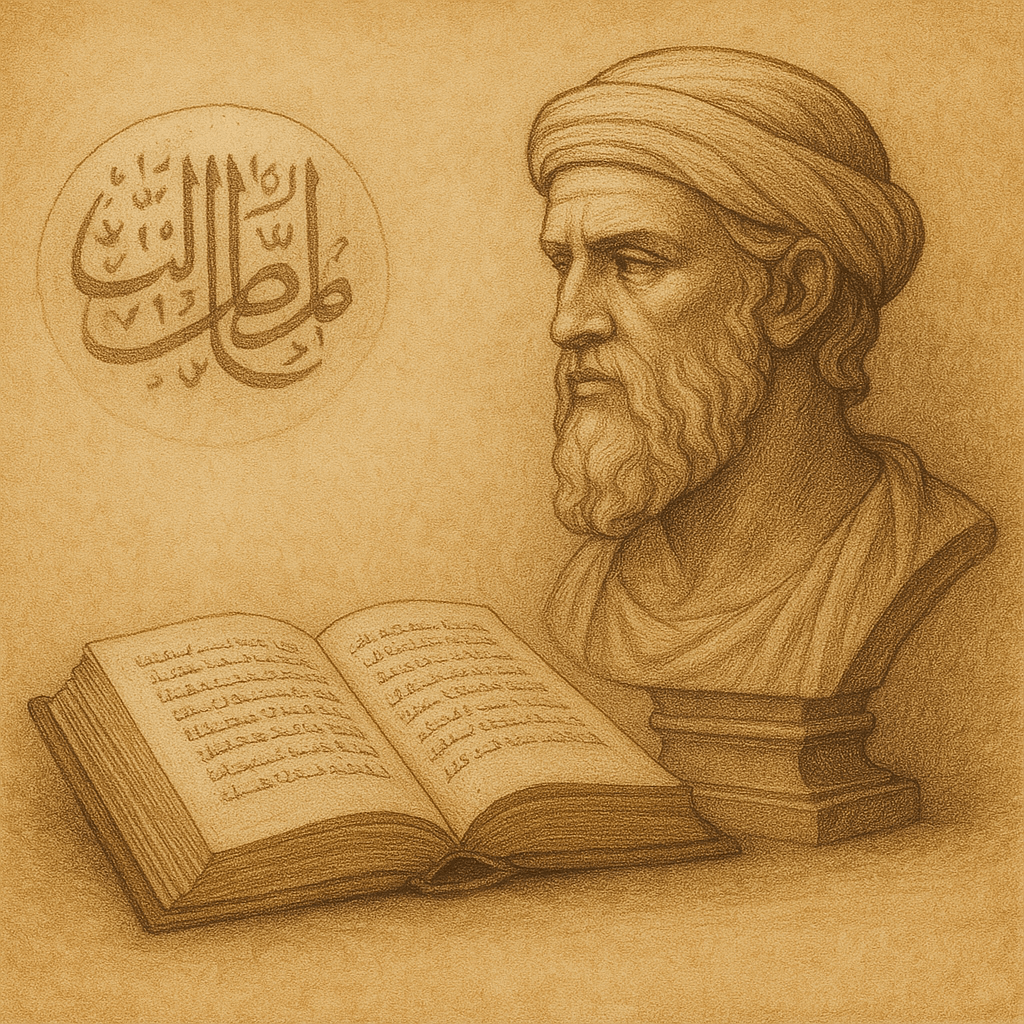
Introduction
Contemporary Salafi-Athari thinkers often champion a return to the unadorned creed of the pious ancestors (al-salaf al-ṣāliḥ) and vehemently critique the traditions of ʿilm al-kalām (Islamic speculative theology) and falsafa (Islamic philosophy) as illegitimate intrusions into Islamic theology. Popular online figures such as Mohammed Hijab frequently denounce kalām and falsafa as heretical innovations that rely too heavily on human reason, vowing instead to stick to scripture and the early scholars’ teachings. Ironically, however, a close examination of their debates and writings reveals that these same critics often employ modes of reasoning, argumentation, and conceptual categories that are indebted to the Greco-Roman intellectual legacy. In other words, even as they reject the formal traditions of kalām and falsafa, their own apologetic arguments rest on philosophical frameworks first developed by ancient Greek thinkers and transmitted through centuries of Islamic thought. This article traces the historical distinction between kalām and falsafa in Islam, outlines the Salafi/Athari distrust of these disciplines (especially under the influence of the Ḥanbali school and Ibn Taymiyyah), and then demonstrates with detailed examples how modern Athari polemicists like Mohammed Hijab inadvertently ground their arguments in Hellenistic reasoning. Finally, it offers a critical reflection on the inescapability of intellectual inheritance and how acknowledging this fact could enrich future Islamic theological discourse.
Kalam and Falsafa in Islamic History: A Distinction of Approaches
Classical Islamic thought developed two distinct approaches to theology and philosophy, known as kalam and falsafa. Ilm al-kalām (literally “science of discourse”) is the tradition of speculative theology that uses rational argumentation to defend and elaborate Islamic doctrine. It arose in the early centuries of Islam as Muslim theologians encountered philosophical and religious challenges from both internal schisms and external ideas. Tradition holds that Wāṣil ibn ʿAtā’ (700–748 CE), founder of the Muʿtazilite school, was among the first to formalize kalām methods by applying logical reasoning to questions of faith. As Islam expanded into regions steeped in Greek and Persian philosophy, early mutakallimūn (practitioners of kalām) felt the need to “justify Islamic beliefs by means of logic” in order to intellectually equip the faith against sophisticated challenges. Over time, multiple schools of kalām emerged – most prominently the Muʿtazila and their opponents the Ashʿarites (and later Māturīdites) – all committed to defending Islamic creed via rational theology.
By contrast, falsafa (the Arabic rendering of “philosophy”) refers to the Hellenistic philosophical tradition as transmitted into the Islamic world. Beginning in the 8th–9th centuries under the Abbasid Caliphate, Muslim scholars undertook a massive project of translating Greek works on science and philosophy (by Plato, Aristotle, Plotinus, etc.) into Arabic. Thinkers like al-Kindī (d. 873) – often called the first Muslim faylasūf (philosopher) – and later al-Fārābī (d. 950) and Ibn Sīnā (Avicenna, d. 1037) sought to systematize Islamic thought using the conceptual vocabulary of Aristotle and Neo-Platonism. They applied Greek metaphysics and logic to questions of God, creation, and the soul, birthing an Islamic philosophical tradition parallel to (and sometimes intertwined with) kalām. Importantly, falsafa did not begin from religious scripture; it began from premises of Greek philosophy, then attempted to harmonize them with, or apply them to, Islamic doctrine. For example, translations adapted Aristotle’s concept of the “First Cause” or “Unmoved Mover” by identifying it with Allah, even while preserving Aristotle’s abstract understanding of that First Cause. The great Andalusian philosopher Ibn Rushd (Averroes, d. 1198) famously defended Aristotle’s view of a necessary, ever-active First Mover as more coherent than the kalām view of a God who creates ex nihilo, highlighting the methodological rift: falsafa tried to reason upward from the world to God, whereas kalām generally started with revelation about God and reasoned downward to the world.
Despite their differences, kalām and falsafa inevitably influenced each other over time. By the 12th century, the boundaries had blurred – theologians like al-Ghazālī (d. 1111) utilized philosophical arguments even as he staunchly refuted the philosophers, and philosophers like Ibn Rushd engaged kalām arguments in defending philosophy. Indeed, the ultimate “victory” of Ashʿarite kalām over falsafa (conventionally marked by al-Ghazālī’s Incoherence of the Philosophers) did not erase philosophy’s influence so much as naturalize it within theological discourse. As historian Ibn Khaldūn observed, although both kalām and falsafa rely on speculative reason, kalām at least “starts with the articles of faith revealed by God…thus maintaining a foothold in the spiritual world,” whereas falsafa begins purely from reason and the physical world. This framing by Ibn Khaldūn acknowledged that excessive rationalism was a shared defect, but it deemed kalām the safer approach since it anchored reason to revelation. Nevertheless, even kalām’s use of Aristotelian logic and metaphysics marked a profound departure from the pure scripturalism of Islam’s earliest generations. It is precisely this departure that the Salafi-Athari movement – both classical and contemporary – finds problematic.
Salafi-Athari Tradition and the Rejection of Kalam and Falsafa
The Athari creed (associated with the early Sunni “traditionalists” and later embodied by the Ḥanbali school) reacted strongly against the rise of kalām and falsafa. From as early as the 8th–9th centuries, many scholars of the Salaf (the first three generations) warned that speculative theology and imported philosophy were perilous deviations from the simple, direct teachings of the Qur’an and Sunnah. Imam al-Shāfiʿī (d. 820) famously remarked: “My ruling regarding the people of kalām is that they should be beaten with palm leaves and shoes, paraded among the tribes, and it announced: This is the reward of one who abandoned the Book and the Sunnah for kalām.”* Such condemnations were not isolated. The Andalusian hadith scholar Ibn ʿAbd al-Barr (d. 1071) noted a unanimous agreement among the early jurists and traditionists that the “people of kalām” are ahl al-bidʿah (innovators) and not true scholars of Islam. In this view, kalām was seen as a blameworthy innovation that corrupts pure faith with speculative disputation. Some even went so far as to say that falling into any sin would be better than delving into kalām, given its spiritually corrosive effects. This uncompromising stance was part of a broader Athari epistemology which held that all necessary knowledge of God and creed is contained in revelation and the understanding of the Salaf, with no need for Greek metaphysics or rationalist dialectics.
By the medieval period, Ibn Ḥanbal’s followers and other Atharis carried this torch of anti-kalām sentiment. The most influential later figure in this trend was Taqī al-Dīn Ibn Taymiyyah (d. 1328), a Ḥanbali scholar who launched aggressive critiques against both falsafa and the kalām of the Ashʿarites. Ibn Taymiyyah is widely regarded as an anti-rationalist in the sense that he rejected the authority of Greek-inspired logical methods in theology. In his polemical works – notably al-Radd ʿala al-Manṭiqiyyīn (“Refutation of the Logicians”) – he denounced Aristotelian syllogistic logic, arguing that it was an alien import leading Muslims astray. He believed that the use of formal logic and speculative philosophy had produced unwarranted doctrines (such as the negation of God’s attributes or the belief in an abstract necessary being) that deviated from the God of the Qur’an. According to one analysis, Ibn Taymiyyah held Greek logic itself responsible for the heretical metaphysical conclusions of the philosophers and speculative theologians. He thus called for a return to what he considered the original, pristine methodologies of the Salaf – a reliance on direct textual evidence and fiṭrah (innate natural intuitions) over imported rationalism. As Majid Fakhry summarizes, “Ibn Taymiyah protests against the abuses of philosophy and theology and advocates a return to the orthodox ways of the ancients…determined to abolish centuries of [innovations] that had troubled [Islamic creed] by theological and philosophical controversies.”
Crucially, the Salafi-Athari distrust of kalām was not a wholesale rejection of reason, but a rejection of certain types of reasoning deemed speculative or rooted in non-Islamic epistemologies. Atharis assert that human reason has limits and must remain subordinate to divine revelation. They worry that unfettered rational speculation leads to distortion of creed – for example, by reinterpreting God’s attributes in light of philosophical notions rather than accepting them bilā kayf (without asking “how”). A modern summary of the Athari mindset explains that reliance on rationalist theology is believed to cause deviation (bidʿah) and internal discord, and that any use of reason in theology must be kept in check to avoid contradicting the clear texts. Classical Atharis like Ibn Ḥanbal and Ibn Taymiyyah thus permitted rational arguments only within a Quranic paradigm and mostly for the purpose of refuting others, not for constructing novel doctrines. Even then, they preferred using Qur’anic terminology and concepts over Greek philosophical language. For instance, rather than negating God’s corporeality by saying “God is not a body (jism)” – a phrase with origins in Greek-influenced theology – they would simply affirm what God affirms about Himself and maintain silence on ambiguous matters. Ibn Taymiyyah and his student Ibn al-Qayyim accused the proponents of kalām of effectively forcing orthodox believers to adopt the language of Aristotle and the Neoplatonists in order to debate them, thereby corrupting Islamic discourse. To the Atharis, it was better to avoid the entire venture of speculative theology than to get entangled in what they saw as endless dialectical hair-splitting with little spiritual benefit.
In sum, by the pre-modern era the fault lines were clear: the Salafi/Athari tradition identified itself with scriptural literalism and rejection of “foreign” philosophical influences, while viewing kalām and falsafa as at best unnecessary and at worst dangerously misguided. This oppositional stance became a hallmark of later Salafism (e.g. the Wahhābī movement of the 18th century reiterated the early Salaf’s censure of kalām). As we turn to the present day, many self-described Salafis and Atharis continue to echo these critiques. They pride themselves on “following the Salaf” in condemning speculative theology, and they often cite figures like Ibn Taymiyyah as authorities for steering clear of Greek-inspired thought. On a theoretical level, then, contemporary Atharis reject the use of kalām and falsafa in arriving at or defending theological truths. On a practical level, however, the challenges of modern discourse – particularly engagement in public debates with atheists, Christians, and others – have pushed some of these very individuals to employ lines of reasoning strikingly similar to those used by the philosophers and theologians of old. This tension between theory and practice gives rise to what can be called the Athari paradox of today: condemning Greco-Roman reasoning, even while leaning on it to make one’s case.
Contemporary Athari Voices and Their Critique of Kalam
In the age of YouTube and public interfaith debates, a number of Muslim figures who identify with Athari or Salafi theology have risen to prominence. They position themselves as defenders of Sunni orthodoxy against atheism, Christian theology, liberalism, and other viewpoints. In doing so, these speakers often emphatically distinguish their approach from that of the traditional Islamic theologians (mutakallimūn) or philosophers. For example, Mohammed Hijab – a well-known debater and activist – explicitly affiliates himself with the Athari-Ḥanbali creed and has criticized Ashʿarite and Māturīdī kalām scholars in some of his talks. He and others in his circle (such as some members of the UK-based Sapience Institute or iERA apologetics group) argue that Muslims today should rely on the Qur’an, the Sunnah, and sound basic reasoning (ʿaql) grounded in fitrah, rather than the elaborate metaphysical frameworks of later Islamic theology. In practical terms, this means they often accuse the kalām tradition of having been corrupted by Greek philosophy and claim to eschew its methods. Public-facing Salafi preachers have been known to warn their audiences about the “dangers” of philosophy: for instance, Abū Iyād Amjad Rafiq (an English Salafi translator) has authored articles with titles like “The Condemnation of the Salaf upon ʿIlm al-Kalām”, compiling classical quotes to dissuade Muslims from engaging in speculative theology. At Speaker’s Corner in London and on social media, Salafi duʿāt (missionaries) have at times even sparred with each other over this issue – notably, debates erupted around whether using philosophical arguments in daʿwah compromises one’s Athari principles. An example of this was a public exchange between Muhammad Hijab and a Salafi preacher known as Shamsi, where Shamsi admonished Hijab for “using Greek logic” instead of sticking purely to Qur’anic arguments (an exchange circulated on YouTube as “Philosophy or Quran?!”). The very phrasing – “I’m not talking about Greek logic”, as one Salafi put it – highlights that even within the Salafi community, an aversion to Hellenic reasoning is a badge of authenticity.
On the surface, these contemporary Athari voices sound just like their predecessors in condemning kalām and falsafa. They dismiss the use of formal logic, syllogisms, and abstract metaphysics as unnecessary for the common believer and potentially corrosive to faith. However, when engaging sophisticated opponents – such as atheists armed with philosophical arguments against God’s existence – the same Salafi-Athari apologists often find themselves employing remarkably philosophical arguments in return. They rarely admit that these tools come from the kalām tradition or Greek philosophy; instead, they tend to rebrand them as simple “rational arguments” or claim they are derived from the Qur’an itself. A case in point is the way the Qur’an’s own arguments are emphasized. Advocates like Hamza Tzortzis argue that “the Qur’an often presents rational intellectual arguments” and that one can derive all necessary proofs for God from the Qur’an’s text. He cites how the Qur’an (52:35-36) challenges disbelievers by asking rhetorical questions (“Were they created from nothing? Or did they create themselves?”), then proceeds to formalize this into a stepwise logical argument about finite things needing causes. In Tzortzis’s formulation, the possible explanations for something’s existence are enumerated and eliminated one by one (it either came from nothing, or created itself, or was created by something created, or by something uncreated – with only the last being viable). This method – breaking an argument into logical possibilities and systematically refuting them – is essentially the same method used by classical mutakallimūn and philosophers, even if couched in Quranic language. Indeed, Tzortzis acknowledges that “this form of reasoning is universal” before attributing a “more robust variation” of it to the Qur’an. Thus, in trying to avoid the charge of using “Greek logic,” modern Salafis often emphasize that they are merely amplifying arguments already present in scripture.
Yet the resemblance of these arguments to traditional kalām/falsafa proofs is undeniable. Without openly saying so, figures like Mohammed Hijab have deployed what are essentially Avicennan and Aristotelian arguments for God’s existence in their debates and writings. Hijab in particular is known for championing the “contingency argument” (Burhān al-imkān) for the existence of God – an argument with deep roots in Ibn Sīnā’s philosophy and later adopted by figures like Leibniz in the West. In 2021 Hijab even authored a book titled Kalam Cosmological Arguments, in which “the author grapples with both medieval and contemporary interrogations of the argument with reference to Greek, Enlightenment and Medieval philosophers.”. The very fact that Hijab’s work engages Greek and medieval philosophy shows that, despite identifying as an Athari, he finds value in dialoguing with those intellectual traditions. The Kalam Cosmological Argument (KCA) – popularized in modern times by Christian theologian William Lane Craig – is itself an inheritance of Islamic kalām (Al-Ghazālī’s argument about the impossibility of an infinite past) and ultimately of Aristotle’s physics (the concept that an actual infinite cannot exist in real time). Salafi-oriented duʿāt often use the KCA almost verbatim: “Everything that begins to exist has a cause; the universe began to exist; therefore the universe has a cause (Creator).” While they may not cite Aristotle or Al-Ghazālī by name, they are undeniably invoking the logical structure those predecessors developed.
Greco-Roman Modes of Reasoning in Salafi Apologetics: Examples and Analysis
To illustrate how contemporary Athari arguments are grounded in Greco-Roman frameworks, we can analyze the content of their debates and publications. Consider Mohammed Hijab’s usage of the contingency argument in a debate setting. He often argues along these lines (paraphrased from his presentations): “The universe and everything in it is contingent – composed of parts, limited, and dependent – so it requires a necessary being as an explanation. This necessary being cannot be composite or material, because anything material is made of parts and hence dependent. Therefore, the ultimate cause must be immaterial, indivisible, and necessary in itself.” In one recorded debate, Hijab explicitly stated: “It cannot be a material entity… logically it cannot be a material entity. Everything which is a material entity is a composite configuration, and… a composite configuration is dependent upon its constituent parts. If something is dependent upon its parts to exist, it must be dependent; and if it’s dependent it can’t be necessary.”. This chain of reasoning is a straightforward application of Aristotelian and Avicennan metaphysics: it draws on the idea that a necessary being must be one and simple (non-composite), because if it had parts it would not be self-sufficient. The notions of composite vs. simple, necessary vs. possible (contingent) are categorically philosophical. Classical philosophers like Aristotle discussed how a First Cause could not be composed of matter, and Ibn Sīnā built an entire proof of God around the concepts of wājib al-wujūd (necessary existence) versus mumkin al-wujūd (possible existence). Hijab’s argument is effectively a restatement of Ibn Sīnā’s proof: as Ibn al-Qayyim summarized it, the philosophers say that “all bodies are composed (murakkab); anything composite is needy (dependent) on its parts; anything needy or contingent (mumkin) requires an agent whose existence is necessary (wājib). And any multiplicity in the essence of that Necessary Existent is impossible, since that would imply composition and need, contradicting its necessary existence.”. Every element of Hijab’s reasoning – from the dependence of composite entities to the requirement of a non-composite necessary being – comes straight from this Avicennan syllogism, which is firmly rooted in Greek metaphysical thought (ultimately going back to Neoplatonic concepts of the One).
What is striking is that Hijab and others present this argument as if it were simply plain logic or Quranic common sense, without openly acknowledging its Greco-Roman pedigree. In fact, Hijab has gone to lengths to defend the use of such rational arguments in Islam by retroactively trying to Islamize them. He and his colleagues often point out that terms like “necessary” and “contingent” can be correlated with Quranic ideas of Allah being al-Ṣamad (independent, self-sufficient) while creation is dependent on Him. To be fair, there is an indigenous Islamic rationality in the Qur’an and Sunnah – the Qur’an does encourage reflection on signs and uses reasoned arguments. But the form of a syllogistic proof about metaphysical necessity is clearly an import. Even some Salafis have recognized this inconsistency. A Salafi critic writing on the website Aqidah.com notes acerbically that Mohammed Hijab, “a self-described Athari/Hanbali,” nonetheless “uses Avicenna’s (Ibn Sīnā’s) arguments of tarkīb (composition) and takhṣīṣ (specification) … taken from Ibn Sīnā and the Muʿtazilah”. In the eyes of such hardline Atharis, Hijab has essentially crossed into the territory of the mutakallimūn he claims to refute, by adopting their usūl (foundational premises). The critique goes further: since historically Ibn Sīnā and the Muʿtazilites used the argument from composition to deny Allah’s attributes (arguing that if God had multiple attributes or parts, He would not be one necessary essence), a purist Athari would worry that Hijab’s line of reasoning could undermine the scriptural description of God. In other words, by using the philosophers’ proof to affirm God’s existence, one implicitly risks affirming their conception of God – a purely simple, abstract entity devoid of the qualities (mercy, love, will, etc.) that the Qur’an affirms. This tension is precisely what Ibn Taymiyyah warned about: that borrowing Greek philosophical arguments comes with theological baggage. If one proves God by denying composition, one may end up with a deity closer to Aristotle’s unmoved mover than to the God of Abraham.
Despite these warnings, modern Salafi apologists evidently feel that the benefit of using these arguments outweighs the risk, especially in debates with atheists. The contingency argument and the kalām cosmological argument have become staples of Muslim apologetics, even among those who simultaneously claim to reject kalām. For instance, another well-known figure, Hamza Tzortzis, routinely employs the cosmological argument and arguments from design in his literature and debates. He presents them as rational supports for Quranic teachings – even branding one version “the Quranic argument for God’s existence” – but the structure of the arguments follows the templates laid down by Greek and medieval philosophers. Tzortzis has faced similar intra-Salafi criticisms: an article on Aqidah.com accuses him of “reviving some of the principles of the Jahmiyyah and Muʿtazilah” by relying on their rationalist method of demonstrating the universe’s origination. The author notes that, just as in classical times those rational methods “ultimately required the negation and denial of the major symbols of Islamic belief” (such as God’s attributes and His elevation above the Throne), so too do these modern arguments risk reducing God to an overly abstract concept. The polemic may be exaggerated, but it underlines a genuine philosophical critique: the content of many Salafi apologetic arguments is indistinguishable from the content of the kalām arguments they deride.
Let us enumerate some of the Greco-Roman elements quietly at work in these contemporary discourses:
- Aristotelian Logic and Syllogisms: The use of propositions, logical operators, and syllogistic deductions is ubiquitous in modern debates. Mohammed Hijab has even given basic lessons on formal logic (e.g. explaining propositional logic on his platforms) to help Muslims engage in debate. The structure of arguments like the cosmological proof is syllogistic (“If everything that begins to exist has a cause, and the universe began, then it has a cause”). This framework was formalized by Aristotle. In fact, Ibn Taymiyyah’s own student reported that “Ibn Taymiyyah zealously denounced syllogism, which provided the rational foundations for both kalām and falsafa”. Yet today’s Athari-inspired debaters rely on syllogisms as a matter of course when arguing with academics or philosophers.
- The Principle of Non-Contradiction and Metaphysical First Principles: When arguing, for example, that an actual infinite cannot exist in reality (a key premise in kalām cosmological arguments), Muslim apologists are invoking a principle discussed since Aristotle (who argued an actual infinite cannot be traversed, etc.). The idea that causal chains cannot regress infinitely and must terminate in an unmoved mover or first cause is straight from Aristotle’s Physics and Metaphysics. It entered Islamic thought via falsafa and kalām, and now is used by Salafi debaters to prove the necessity of a first cause (God). They will insist this is just “logical necessity,” not Greek per se – but historically, this exact argument was introduced by philosophers engaging Hellenic ideas. Al-Ghazālī used it (from Aristotle) against Ibn Sina’s eternalist cosmology in Tahāfut al-Falāsifa, and today it lives on in the repertoire of Salafi apologists (as well as Christian ones like William Lane Craig). This underscores how inescapable certain Greek logical principles have become in arguing about God’s existence.
- Ontology of Necessary vs. Contingent Being: As discussed, the contingent-being argument is Avicennian. Terms like “necessary existence” (wājib al-wujūd) and “contingent existence” (mumkin al-wujūd) come straight from the lexicon of falsafa. Even the notion of dividing existence into necessary, possible, and impossible categories is a logical exercise foreign to the Qur’anic mode of discourse (which does not explicitly parse reality in those terms). Muslim apologists who talk about God as the “Necessary Being” without need of a cause, versus the universe as “contingent being” in need of one, are operating within an intellectual framework built by Greek metaphysics and Islamic philosophers.
- Dialectical Method (Jadal): The style of disputation itself – setting up an opponent’s argument, then refuting it point by point – has roots in Greek dialectic (as well as in the Islamic tradition of juristic debate, munāzara). The early Salaf were generally averse to indulging in excessive jadal (theological disputation), but today’s debaters thrive on it as a means of defending Islam. The method of posing hypothetical questions and walking through rational outcomes (e.g. “Could the universe come from nothing? Could it create itself? No. Therefore…”) resembles the Socratic and Aristotelian method of elimination and deduction. It’s certainly an effective pedagogical tool, but it’s far removed from the mode of the Qur’an, which, while asking people to reason, does not lay out step-by-step logical proofs in this fashion. The modern debater has effectively merged Quranic content with Greek form.
- Terminology and Concepts: Even when not explicitly naming philosophers, the conceptual categories used betray a Hellenic influence. Words like “material,” “immaterial,” “contingent,” “infinite regress,” “parts and wholes,” “necessary existence,” “causality,” “essence and attributes,” etc., which pepper the speeches and writings of these apologists, all have long histories in Greek and later Islamic thought. In one exchange, Mohammed Hijab connected his “Necessary Being” argument to Quranic terminology by citing Sūrat al-Ikhlāṣ (112:1-4) – “Say: He is Allah, the One, Allah al-Ṣamad (the Self-Sufficient)… and there is none like unto Him.” He argued that God’s oneness and self-sufficiency (al-Ṣamad) correlate with the notion of a non-composite, necessary existent. While this is a creative bridge between scripture and philosophy, it still indicates that he is reading the Qur’an through a lens ground by Aristotle and Avicenna (by focusing on notions of composition, self-sufficiency, etc., that the philosophers emphasized).
In light of the above, it becomes evident that contemporary Salafi/Athari polemicists owe a considerable intellectual debt to the Greco-Roman tradition, whether acknowledged or not. Some of them, to be fair, are quite learned in philosophy and do know the origins of these arguments – they may justify their use by saying that “wisdom is the lost property of the believer” (a saying attributed to the Prophet), meaning Muslims can take and repurpose beneficial knowledge from any source. Indeed, we see a measure of pragmatic borrowing going on: while condemning “philosophy” in general, they selectively adopt philosophical arguments that serve apologetic goals, wrapping them in Islamic terminology to make them more palatable. For example, instead of referencing Aristotle’s Prime Mover, they will speak about “Allah, the First and Last” but imply the same concept of an uncaused cause; instead of citing Al-Fārābī or Avicenna on why God must be simple, they quote Quranic verses about God’s oneness and say “logically, this means He’s not composite.” The substance is unchanged – only the packaging differs.
The Paradox and Its Critics: Athari Response to the Use of Philosophy
It is worth noting that not all within the Salafi-Athari camp are comfortable with this philosophical turn in apologetics. As mentioned, there have been intra-Salafi refutations targeting people like Hijab and Tzortzis, accusing them of betraying Athari principles. One such critic, after analyzing Hijab’s contingency argument, lamented: “The Salaf considered all of this type of language as innovation and misguidance.” According to this view, even if the argument arrives at a true conclusion (affirming God’s existence), the method is blameworthy – and using a forbidden method is not justified by a seemingly good outcome. These hardliners argue that victory in debate is meaningless if one “loses the plot” by adopting the paradigm of one’s opponents (in this case, the paradigm of speculative philosophy). They often advise returning entirely to Qur’anic arguments, by which they mean arguments that rely on fitrah (innate disposition) and simple inference rather than technical metaphysics. For example, they prefer the Quranic argument from design or purpose – e.g. “Were they created from nothing?” or “Look at the camel, how it was created” – to the philosophers’ argument from contingency or motion. This mirrors, in a modern context, the stance of figures like Imam Aḥmad ibn Ḥanbal, who when asked to justify theology would reportedly just quote a verse or hadith and shun abstract reasoning.
However, other Salafi-oriented scholars have taken a slightly more accommodating stance, acknowledging that some rational argumentation is unavoidable in today’s intellectual climate. For instance, Yasir Qadhi (a scholar with Salafi training who later moved to a more academic approach) noted in one lecture that while the Salaf avoided kalām due to its excesses, later scholars like Ibn Taymiyyah did master logic and philosophical arguments in order to defeat opponents on their own terms – albeit Ibn Taymiyyah tried to reformulate those arguments in an Islamically acceptable way (claiming to base them on “sound reason” and fitrah rather than Aristotle’s formal logic). In Qadhi’s assessment, completely abstaining from rational debate is untenable if atheists and missionaries are using philosophy to attack Islam; Muslims must respond in kind, but should do so carefully and without letting the philosophy dictate their creed. This moderate view resonates with what some classical scholars like al-Ghazālī believed: kalām is like a medicine – used in correct dosage it can repel doubts, but taken in excess it becomes a poison. The key is to remain grounded in revelation even as one uses rational tools.
Thus, within the broad Salafi/Athari scene, there is an ongoing negotiation about how much “Greek stuff” can be used before one ceases to be Athari. Mohammed Hijab himself, in responding to his Salafi critics, argued that what he is doing is not the forbidden kalām of the mutakallimūn, but rather a legitimate form of intellectual jihad to defend Islam using every tool at his disposal (language, internet, logic, etc.). In an audio response titled “Reply to Pseudo-Salafi Critique of the Contingency Argument” (2022), Hijab emphasized that Greek logical terms are just means to explain the truth of God’s existence and that one should not throw away effective arguments simply because non-Muslims also use them (paraphrasing his defense). He pointed out that even communicating in English or using the internet involves engaging with non-Islamic inventions; by analogy, using terms like “necessary being” is just employing the intellectual vocabulary dominant today. What matters, he would say, is that the argument’s conclusion aligns with Islamic tawḥīd and that we do not adopt any false premises that contradict revelation. This is a clever rebuttal, but it still leaves open the question: are those premises truly free of contradiction with revelation? His Salafi detractors would say no – they believe that the premises of the contingency argument subtly carry Muʿtazilite or Jahmite theology, such as implying that God has no real attributes or that “material composition = imperfection,” which led Jahm b. Ṣafwān to deny Allah’s attributes in the first place. Hijab insists that he stops short of that and only uses the argument to prove a creator, not to redefine Allah. The debate here is highly technical, but it underscores the philosophical tightrope that Athari apologists walk: they want the persuasive power of Greek logic without the theological baggage. Whether that is fully possible is still a matter of contention.
Conclusion: The Inescapability of Intellectual Inheritance
The foregoing analysis reveals a rich irony: those who claim to follow the earliest Muslim ancestors in rejecting “foreign” modes of thinking are nonetheless heirs to those very modes in their own arguments. The reality is that no intellectual tradition develops in a vacuum. Islam’s encounter with Greek thought in the medieval era “undeniably shaped the course of [Islamic] philosophical and theological thought,” leading even its opponents to define themselves in relation to it. Indeed, the legacy of that encounter is so profound that, as one historian puts it, “Islam accepted late-Classical Greek attitudes to such an extent that, almost by default, they became an important part of its own tradition.” The modern Salafi movement, despite its calls to purge innovations, is itself operating within a discourse environment deeply conditioned by centuries of philosophical theology. Terms and distinctions that arose from kalām and falsafa have seeped into the general Islamic consciousness. So when a 21st-century Muslim debater wants to prove God to an atheist, he will almost inevitably reach for concepts like causality, infinity, contingency, and design – all of which carry the imprint of the Greco-Roman legacy that entered Islam long ago. This does not diminish the Qur’an or Sunnah; rather, it shows that Muslims, like all communities, build on intellectual inheritances even as they critique them.
Far from being a source of embarrassment, acknowledging this inheritance can be a source of strength. It allows Muslim theologians and daʿīs to be more self-aware and critical about the tools they use. By recognizing that what they call “simple logic” often has philosophical presuppositions baked in, they can take steps to ensure those presuppositions do not conflict with Islamic tenets. It can also foster a more nuanced dialogue with the broader Islamic scholarly tradition: instead of dismissing all kalām as deviant, contemporary Atharis might study how past scholars integrated reason and revelation, and learn from both their successes and mistakes. In academic Islamic studies today, there is a greater appreciation that the lines between “rationalist” and “literalist” were never absolute – Ibn Taymiyyah himself engaged in complex reasoning and even Sufi metaphysics in his critiques, demonstrating that one could be an Athari and still have a sophisticated intellectual approach.
The inescapability of intellectual inheritance also implies a humility: one cannot simply hit the reset button and live exactly as the Salaf did, because our context is vastly different. The Salaf did not face mass atheism or the theory of evolution or the barrage of modern philosophies – but we do, and we inevitably use the language of our time to respond. That language will have echoes of Aristotle, of the Enlightenment, of science, and so on. As long as Muslims are careful to filter out what contradicts revelation, this process of intellectual engagement is not only unavoidable but beneficial. It is, after all, how classical Islamic civilization itself blossomed – by absorbing knowledge from Greek, Persian, and Indian sources and Islamizing it. The Atharis were a conscience in that civilization, a reminder not to let syncretism go too far. That role remains important: not to prevent all borrowing, but to constantly check that borrowing against the lodestar of scripture.
Moving forward, future theological discourse in Islam could be enriched by a frank admission that we are all indebted to those who came before, including the ancient Greeks. This does not make Islam “less divine” or “secondary” – it simply reflects that Allah’s wisdom can manifest in different times and places, and truths discovered by human reason can complement revelation when properly understood. A productive way for Salafi/Athari scholars to approach kalām and falsafa today might be: Study them, critique them rigorously where they conflict with Qur’anic principles, but also appropriate from them whatever is useful and sound. In fact, some Salafi scholars have begun to do this, producing works on logic and ethics that draw from broader intellectual resources while maintaining an outward Salafi allegiance. Such efforts could lead to a revitalized “Islamic philosophy of nature” or “theology of science” that speaks to contemporary issues – something the original mutakallimūn certainly would have attempted in our era.
In closing, the tension observed in Mohammed Hijab and his peers is not so much a personal failing as it is a microcosm of Islam’s perennial negotiation with reason. The Athari-Salafi instinct to safeguard the purity of faith is laudable, but it need not manifest as denial of intellectual history. As the proverb goes, those who do not learn from history are doomed to repeat it – and in this case, denial of history can lead one to repeat it unwittingly. By embracing the fact that Greek logic and philosophy have become intertwined with how we discuss theology, Muslims can more consciously shape those tools to serve Islamic ends. The alternative is to use them unconsciously and then deny one is doing so – a recipe for inconsistency, as we have seen. The public critiques of Hijab by traditionalist Salafis, and his counter-defense, show that this conversation is already happening within the community. It can be hoped that, with time, this dialogue will yield a more cohesive approach that honors the Salaf’s commitment to scripture and intelligently engages the rich intellectual inheritance that history has bequeathed. In the end, recognizing the Greco-Roman underpinnings of even the most “anti-philosophy” arguments is the first step toward an intellectually honest and spiritually authentic theology for the modern world.
Sources:
- al-Shāfiʿī, Muḥammad (d. 204 H). Statements on the People of Kalām. In Ibn Abī al-ʿIzz, Sharḥ ʿAqīdat al-Ṭaḥāwiyyah, p. 75.
- Ibn Taymiyyah, Taqī al-Dīn. Al-Radd ʿala al-Manṭiqiyyīn (Refutation of the Logicians). (Analysis in Majid Fakhry’s scholarship).
- Ibn Khaldūn, ʿAbd al-Raḥmān. Muqaddimah (Prolegomena). (Summary of his critique of kalām vs falsafa).
- Ali, Ishraq & Almulla, Khawla. “Philosophy versus theology in medieval Islamic thought.” HTS Theological Studies 79(5), 2023.
- Islamiverse Blog (A. Ishola). “Kalam and Falsafa in Judaism and Islam: Differences, Similarities and Mutual Influences.”.
- Aqidah.com (Abu Iyaad Amjad Rafiq). Series of articles critiquing contemporary use of kalām: e.g. “Muhammad Hijab, the Falasifah, Mutafalsifah and Jahmiyyah,” parts 1–9; “Advice Regarding Hamza Tzortzis and iERA”.
- Hijab, Mohammed. Kalam Cosmological Arguments. Independently published, 2021.
- Tzortzis, Hamza. “The Qur’an’s Argument for God’s Existence.” hamzatzortzis.com (accessed 2025).
- Reddit r/islam discussion, “Ilm al-Kalam and its place in dawah”, 2022 (illustrating community perceptions).
- Debate Transcripts/Recordings: Mohammed Hijab’s debate statements on the contingency argument; Shamsi vs Hijab discussion (Speaker’s Corner, 2019).
- PatterninIslamicArt.com. “Islam’s Greek Inheritance: Mathematics, Science, and Philosophy” (historical overview of translation movement).
- Encyclopedia.com. “Sunni Critique of Kalam and Falsafah” (summarizing Ghazali and Ibn Khaldun, n.d.).
 jerusalemandathens.com