
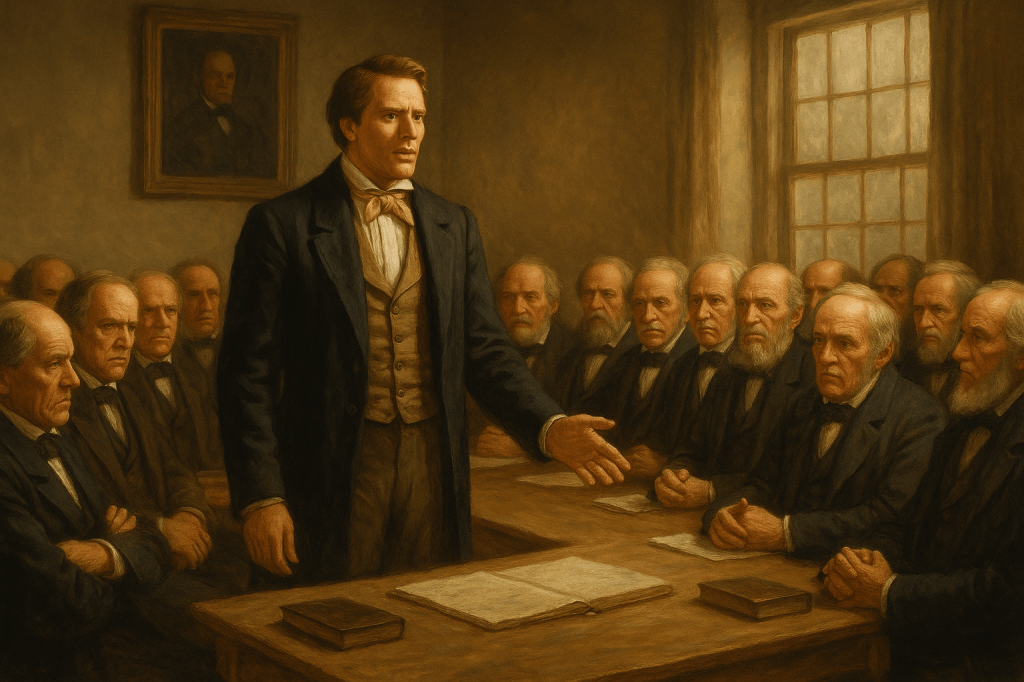
Scriptural and Doctrinal Foundations for Trying a Church President
In early Latter-day Saint history, Joseph Smith taught that no church leader is above accountability. A revelation given in 1835 (now Doctrine and Covenants 107) established a procedure for trying even the President of the Church if he were to transgress. The scripture mandates that “inasmuch as a President of the High Priesthood shall transgress, he shall be had in remembrance before the common council of the church, who shall be assisted by twelve counselors of the High Priesthood; And their decision upon his head shall be an end of controversy concerning him.” In other words, the highest church council – presided over by the Presiding Bishop with twelve high priests as counselors – has authority to discipline or remove the Church’s President, “none shall be exempted from the justice and the laws of God.” This revealed instruction, often called the Common Council of the Church, makes clear that no mortal leader is considered infallible or above divine law.
Early church commentary emphasized this principle. An unsigned 1852 editorial in the Millennial Star (an official LDS publication) strongly rejected blind obedience to leaders. It cautioned that obeying a priesthood leader’s counsel even when “known to be wrong” is “worse than folly…it is slavery in the extreme”. A true “man of God” would “despise the idea” of such blind allegiance. The article warned that any leader teaching absolute, unquestioning obedience likely has “it in their hearts to do wrong themselves”. This reflects an early doctrinal understanding that Church leaders can err, and that members should not suspend personal conscience and discernment. Joseph Smith himself warned the Saints against over-reliance on prophets: those who depended entirely on the Prophet were “darkened in their minds” by neglecting their own duties before God. The foundation of the Church was to be God and personal revelation, not merely trusting a man. In fact, Joseph invited the Saints that if they ever saw him doing wrong, they should tell him so that he could correct it.
Underlying these teachings is a theological premise: prophets and apostles are still fallible humans. In LDS belief, prophets are chosen by God and given authority, but they do not lose their agency or human limitations. The Bible and Book of Mormon likewise caution against trusting mortal arm too absolutely: “Cursed is he that putteth his trust in man” (Jeremiah 17:5; 2 Nephi 28:31). Latter-day Saints are taught to seek confirmation from the Holy Spirit on the teachings of their leaders. The revelation commanding a Common Council for a transgressing President (D&C 107:82–84) explicitly underscores that “none shall be exempted” from God’s laws – including the Prophet. In LDS doctrine, the Church’s true head is Jesus Christ, and all—even the Prophet—are subject to Him and His law. This doctrinal framework provided a mechanism (however rarely invoked) to remove even a Prophet if he were to seriously stray, thereby acknowledging prophetic fallibility in principle.
Historical Instances of the “Common Council” in Practice
In practice, the Common Council of the Church has been formally convened only a few times in history, and only in the early LDS Church. According to historical records, the council (led by the Presiding Bishop with 12 high priests) met twice in Joseph Smith’s era to consider charges against top leaders:
- 1834 – Trial of Joseph Smith: After the difficult Zion’s Camp expedition, dissent arose. A man named Sylvester Smith accused Joseph Smith of mismanagement of funds and other improprieties. In response, Joseph submitted himself to the Common Council on August 11, 1834. Presiding Bishop Newel K. Whitney assembled twelve high priests (including future Apostle Amasa Lyman and others) as counselors. After hearing the charges, the council unanimously exonerated Joseph Smith, finding that he had “acted in every respect in an honorable and proper manner” with the funds entrusted to him. Notably, this was the first and only time a sitting Church President has been tried by this council. The event set a precedent: Joseph himself demonstrated that even the President could be subject to church discipline in an orderly way, if needed.
- 1844 – Trial of Sidney Rigdon: Sidney Rigdon had been First Counselor in the First Presidency. After Joseph Smith’s martyrdom in June 1844, Rigdon claimed the right to lead the Church as its “Guardian.” This claim conflicted with the authority of the Quorum of the Twelve Apostles (led by Brigham Young), who also asserted leadership. Tensions mounted, and in September 1844, Presiding Bishop Whitney again convened the Common Council – this time as a public disciplinary hearing in Nauvoo. Twelve high priests were called as the council (including Brigham Young, Heber C. Kimball, Parley and Orson Pratt, John Taylor, and others of the Twelve). Rigdon was charged with insubordination and aspiring to higher authority than that authorized – he had even begun ordaining his own followers to new offices not recognized in the Church. Rigdon declined to attend in person (having fled Nauvoo), so the council tried him in absentia. The council found him guilty of fomenting schism and formally excommunicated Sidney Rigdon from the Church. This was a dramatic instance of the highest leaders using a church court to remove a wayward counselor in the First Presidency.
Aside from those two 19th-century instances, the formal Common Council mechanism has essentially never been employed again in the LDS Church’s mainstream history. Both cases took place during Joseph Smith’s lifetime or immediate aftermath. After 1844, leadership succession fell to Brigham Young and the Quorum of Twelve, and the church headquarters moved west. In the Utah era and beyond, no President of the Church has ever been disciplined or removed by any council – no later prophet has faced a formal trial for transgression, and thus the Common Council lay dormant. In fact, the very existence of this council became somewhat obscure. Its status in modern Church governance is uncertain and rarely discussed. The principle remains canonized in scripture (D&C 107), but in practice the Church has not needed to invoke it. The understanding since the late 19th century is that God would remove a prophet who seriously went astray (through death or loss of divine authority) before he could lead the Church into error – a belief we will discuss later. Thus, while the Common Council is part of LDS doctrine and history, it has been practically unused for over 180 years, essentially a contingency plan that never needed activating after the 1840s.
It should be noted that although no President after Joseph was tried, the Church did see other high-ranking leaders apostatize or require discipline in its early history. The First Presidency counselors to Joseph Smith provide examples: William Law, a counselor to Joseph in Nauvoo, openly rebelled over plural marriage and published the Nauvoo Expositor against Joseph; he was excommunicated in 1844 for apostasy. Sidney Rigdon’s case we have seen. Even Oliver Cowdery, who was the Assistant President of the Church and second only to Joseph in authority, fell into disfavor and was excommunicated in 1838 (though he later returned to the Church before his death). The pattern was clear that any leader, no matter how senior, could be removed for serious transgression or opposition.
Apostles and Prophets Can Fall: Historical Examples of Apostasy in the Highest Ranks
History further underscores that apostles and other top leaders are not immune to error or even outright apostasy. During Joseph Smith’s lifetime, a significant number of the early Apostles and leaders did falter, illustrating the point that calling does not guarantee lifelong faithfulness:
- Judas Iscariot (New Testament): Even among Christ’s original Twelve Apostles, one fell. Judas, though called by Jesus, betrayed the Lord, demonstrating tragically that free will can override calling (see John 6:70).
- Original LDS Twelve Apostles (1830s): The Quorum of Twelve organized in 1835 saw several members leave the Church during the Kirtland and Missouri crises. Notably, Thomas B. Marsh, the President of the Twelve, apostatized in 1838 over a dispute and false reports, and was excommunicated. William E. McLellin, Luke S. Johnson, Lyman E. Johnson, and John F. Boynton (all original Twelve) also fell into apostasy by 1837–38 and were excommunicated or left the Church. In fact, a majority of the original Twelve Apostles were released or excommunicated within a few years of their calling, due to various conflicts and failures of faith. Some (like Orson and Parley Pratt) had temporary estrangements but returned to full fellowship, but many others never returned. This turbulent early period proved that apostolic office did not guarantee unwavering loyalty or correctness – human weaknesses (pride, dissent, sin) could affect even those called as prophets and apostles.
- Other 19th-Century Apostles: In later years, a few members of the Twelve also fell. Amasa Lyman, an Apostle and close associate of Brigham Young, began teaching false doctrines (denying the atonement of Christ) and was eventually excommunicated in 1870. Albert Carrington, an Apostle, was excommunicated in 1885 for adultery. These cases, though uncommon, reinforced that even an Apostle can “become a transgressor” and be cut off if they do not repent – fulfilling the Lord’s warning that “if thy foot (offensive leader) offend thee…he shall be cut off” (Joseph Smith Translation of Mark 9:40–48) as applied in a church context.
- First Presidency Counselors: We have mentioned Joseph Smith’s counselors (Rigdon and Law) who apostatized. In the 20th century, it has been extremely rare for a First Presidency member to go astray; however, it did occur that a few high leaders outside the Twelve were disciplined. For instance, George P. Lee, a General Authority Seventy, was excommunicated in 1989 for apostasy (the first General Authority excommunication in decades). While not as doctrinally significant as the 19th-century crises, it was a reminder that high office doesn’t preclude falling into personal transgression or disagreement that leads one out of the Church.
Collectively, these examples underscore a sobering but important reality in Mormon history: holding the office of Apostle, Prophet, or other highest leadership calling does not strip one of human agency or fallibility. Leaders have, on occasion, erred seriously enough to be removed or to remove themselves from the faith. The Latter-day Saint scriptural record affirms this pattern: “many are called, but few are chosen” (D&C 121:34). In other words, receiving a calling is one thing; living up to it fully is another. The Lord may call imperfect humans to leadership to accomplish His work, but if they “have it in their hearts to do wrong” and do not repent, they can lose their standing. Even Jesus chose a Judas among His Twelve – not because Jesus was deceived, but perhaps as a lesson against unthinking trust in human leaders and a demonstration that God allows moral agency even at the highest levels. This doctrinal perspective teaches the Saints to place ultimate trust in God, not in the arm of flesh, no matter how exalted the office (2 Nephi 4:34; 28:31).
Teachings from LDS Leaders on Prophetic Fallibility and Accountability
Far from hiding these principles, early LDS leaders frequently preached about the fallibility of leaders and the necessity for members to use discernment. Their statements form a rich theological commentary on the theme that a prophet can make mistakes – and that it is both acceptable and expected for faithful members to acknowledge that fact.
Brigham Young, second president of the Church, spoke boldly on this topic. In a famous 1862 sermon, he cautioned the Saints against blindly following him or any leader. “What a pity it would be if we were led by one man to utter destruction!” he exclaimed, pointedly asking if the people were afraid that could happen. “I am more afraid,” Brigham continued, “that this people have so much confidence in their leaders that they will not inquire for themselves of God whether they are led by Him.” He warned that the Saints, by settling into “a state of blind self-security, trusting their eternal destiny in the hands of their leaders with a reckless confidence,” could thwart the purposes of God in their own salvation. His consistent exhortation was: “Let every man and woman know, by the whispering of the Spirit of God to themselves, whether their leaders are walking in the path the Lord dictates or not”. This counsel from Brigham Young – the prophet of God at the time – openly acknowledged that it was possible for a leader to lead the people incorrectly if they chose blind obedience over personal revelation. He wanted Church members to gain their own witness of the rightness of any directive, rather than assume the Prophet could never err. Brigham’s frankness shows that early Church leaders expected members to recognize their leaders’ human side. Indeed, he said he feared the people’s unquestioning excess of trust more than the prospect of one man leading them astray.
Likewise, George Q. Cannon, who served for decades in the First Presidency (under Brigham Young, John Taylor, and Wilford Woodruff), taught that Latter-day Saints should keep their faith in God first rather than in the arm of flesh. In 1890 he wrote: “Do not, brethren, put your trust in a man though he be a bishop, an apostle, or a president. If you do, they will fail you at some time or place; they will do wrong or seem to, and your support be gone.”. Cannon’s point was that even the highest Church leaders might someday disappoint if one’s testimony rested solely on the leaders’ personal perfection. A faithful member’s foundation should be Jesus Christ and one’s own witness of truth, not the presumed infallibility of those in office. These remarks, coming from a staunchly loyal counselor to multiple Church presidents, reinforce that LDS leadership acknowledged their own fallibility and cautioned the Saints accordingly.
Even Joseph Smith set this precedent. He said, “a Prophet [is] a prophet only when he [is] acting as such,” implying that at other times he was a fallible man (this oft-quoted saying, though second-hand, encapsulates Joseph’s view of his mortal limitations). On one occasion Joseph rebuked a group of Saints for blindly depending on him: such dependence, he said, caused them to be spiritually “darkened”. Hugh B. Brown, a 20th-century apostle, similarly taught that prophets have erred: “We must not assume that because God has given revelation to [the Prophet] that everything he says or does is inspired”, and he encouraged members to think critically and charitably regarding prophetic messages (this was in a famous 1958 BYU speech advocating openness to truth). All these statements underscore a consistent thread in LDS thought: no teaching of prophetic leadership was ever intended to negate the reality of human agency and imperfection in Church leaders.
It is true that Latter-day Saints also uphold a reverence for the Prophet and emphasize that God guides the Church through him. There is a well-known promise, first articulated by Wilford Woodruff in 1890, that “The Lord will never permit me or any other man who stands as President of this Church to lead you astray. … If I were to attempt that, the Lord would remove me out of my place.”. This statement (now published in the LDS scriptures’ Official Declaration 1) has been reaffirmed by subsequent Presidents. Properly understood, however, it does not mean prophets cannot make any mistakes; rather it’s a reassurance of faith that God will not allow a prophet to utterly derail the Church from its divinely appointed course. President Woodruff’s declaration even contains the mechanism: God would “remove” a wayward leader before he could lead the Church astray. In effect, this is a theological backstop similar to (and in harmony with) the idea of the Common Council: if a prophet were to fall into serious rebellion against God, Providence (or the council acting on God’s law) would oust him. Thus, Latter-day Saints are taught to trust that the Lord is ultimately at the helm, preventing any permanent misdirection. Unfortunately, some members have informally expanded this promise to a notion of near-infallibility – thinking “the prophet can’t be wrong.” That is an oversimplification; our own leaders historically have never claimed personal infallibility. President Harold B. Lee clarified that members “don’t need to worry” about the prophet leading the Church astray because the Lord would remove him before allowing that. In other words, prophetic fallibility is assumed, but God’s overruling power is trusted.
The balance struck in LDS doctrine is an admonition to follow the living prophet’s guidance with faith, coupled with the understanding that this obedience is not blind. We are expected to seek the confirming witness of the Spirit and to remain rooted in gospel principles rather than in any one personality. If something ever seemed truly amiss, the Lord has given channels for correction – through councils, through the voice of the membership (common consent), and through divine intervention if necessary. Indeed, the Law of Common Consent in the Church (see D&C 26:2) requires that members sustain leaders – a subtle reminder that the body of the Church has a duty to withhold support if a leader were teaching blatant falsehood or sin. In 1843, the general conference famously did not sustain Joseph’s attempt to remove Sidney Rigdon as counselor (due to Hyrum Smith’s plea of compassion) – showing that the collective membership had a voice in retaining a leader, for better or worse. That principle still exists (in theory members could oppose a sustaining vote), though it’s rarely exercised. All these layers illustrate a church governance system that recognizes the potential fallibility of even its prophet, yet operates by faith that God will guide and correct as needed.
A “Forgotten” Principle in the Modern Church?
Today, in 2025, the average Latter-day Saint’s awareness of the Common Council or the historical trials of Joseph Smith and Sidney Rigdon is quite low. These episodes are not regularly taught in church classes or mentioned in conference. They survive in scripture (D&C 107) and in historical literature, but one must usually seek them out. Over time, the narrative emphasis in the Church has been on loyalty to prophetic leadership and on the comfort that the Prophet will not lead the Church astray. As one observer wryly put it, “In the Catholic church everyone says the Pope is infallible but nobody believes it; in the Mormon church everybody says the Prophet is fallible but nobody believes it.” In other words, Latter-day Saints unanimously would theologically agree prophets are mortal men prone to mistakes, but in practical terms many members trust the Prophet so completely that the idea of him being seriously wrong is distressing or simply discounted. The historical facts we have reviewed – the provision for a prophet’s trial, the instances of apostolic apostasy, the frank statements of early leaders – can come as a surprise to some “general Mormon” members today precisely because it challenges a more simplistic folk belief that “the prophet can’t ever be wrong.”
Nonetheless, there is a movement, especially among those who engage with church history and scripture deeply, to revive understanding of these timeless principles. Faithful scholars and teachers sometimes highlight D&C 107:82–84 and the principle that “no leader is infallible.” They remind us of Christ’s warning that if even an appointed leader (“thy foot”) offends by transgression, he may be cut off (JST Mark 9:42–48) – implying the Church must be willing to remove unrighteous leaders to protect the body of the Church. Such discussions reinforce that recognizing prophetic fallibility does not undermine faith, but rather grounds faith in the proper source (God) instead of idealizing mortals. A recent analysis noted that many Saints imagine the Church operates almost “by magic” – assuming “somehow, every leader is perfect, every calling inspired, and every man fulfills his duty”, when in reality “many are called, but many do not live up to their calling”. Recovering this knowledge is healthy: it prevents personality cults and unquestioning obedience from taking root, and it can inoculate members against crises of faith if a beloved leader were ever to err. After all, if one wrongly believes “the Prophet can’t make mistakes,” then any mistake (historical or present) might shatter the foundation. But if one understands the true doctrine – that Prophets are guided by God but still human – one can reconcile human error without losing faith in the overall divine guidance of the Church.
In the current mainstream Church, the Common Council exists mostly as a theoretical footnote. Church handbooks today do not explicitly describe a procedure for disciplining a sitting President; it is generally presumed that such a situation won’t arise because of the Lord’s promise to remove a wayward prophet. If, hypothetically, a Church President did gravely transgress, the likely approach (in harmony with D&C 107) would be for the Presiding Bishop and the Twelve to take action in council – but this is unprecedented in the modern Church. More commonly, if a lower-level leader errs, there are established disciplinary councils. For the President of the Church, however, we trust the self-policing nature of the prophetic office (a true prophet will repent or resign if he is offending God) and above all in God’s ability to correct the situation. This trust has been reinforced by nearly two centuries in which no LDS Church President has required removal for apostasy or serious misconduct – a track record believers attribute to God’s preserving hand. Meanwhile, the vivid early example of Joseph Smith willingly facing a council in 1834 stands as a testament that he himself did not claim personal immunity from error or accountability. Joseph’s behavior and the Lord’s revelations set the expectation that a prophet is answerable to the Church and ultimately to God’s laws.
A careful look at LDS history and doctrine reveals a strong, if sometimes neglected, checks-and-balances theology regarding prophetic leadership. The Common Council of the Church – used in 1834 and 1844 – is the clearest institutional expression that “none shall be exempted” from justice in the Church, “thus, none shall be exempted from the justice and the laws of God”. It demonstrated in the faith’s earliest years that even the Prophet could be called to account. Theologically, this undergirds the argument that prophets can make mistakes – even serious ones – and that the Church is equipped (by revelation) to deal with such a contingency. Historically, we see that several apostles and even counselors to the Prophet have fallen from their office, proving that high position does not equal perfection or guarantee endurance in righteousness. And in the teachings of the prophets themselves, we find candid admissions of fallibility and warnings against placing absolute faith in human leaders. Importantly, none of this is to suggest that Latter-day Saints should be cynical toward their leaders. Rather, the intended lesson is to “trust in God” first, seek the Holy Spirit, and sustain our leaders with an open-eyed faith – supportive but not blind. Prophets are empowered by God, but as mortals they can falter if they “lose the Spirit of the Lord,” as was observed in cases like Sidney Rigdon. The genius of the LDS system is that it espouses both loyalty and accountability. Prophets are to be followed when speaking for God, but the ultimate loyalty of the Saints is to truth and righteousness – to God’s law above any man. If ever a leader were to substantially deviate, the doctrine implies God would either correct that leader, or remove him (through divine or institutional means), before lasting damage could be done.
For believing Latter-day Saints, then, acknowledging prophetic fallibility is not a mark of faithlessness but a recognition of God’s wisdom in organizing His Church. It instills humility in both leaders and followers. Prophets need the prayers and watchfulness of the Saints, just as the Saints rely on the prophets’ guidance. Brigham Young’s exhortation remains relevant: the safety of the Church lies in a membership that is spiritually awake – a people who know God’s voice for themselves and thus will not be led to utter destruction, even if a leader erred. In such a Church, a true prophet has nothing to fear from accountability, and a false or fallen one would have no power – for the truth, confirmed to the humble seekers, would win out. This is the grand lesson behind the obscure “Common Council” and the historic episodes of prophetic testing. It is a lesson that, once remembered, can strengthen the faith of Latter-day Saints in 2025: Yes, prophets can be wrong – but the Gospel and the Church do not rest on the infallibility of men. They rest on Jesus Christ, who is the real Head of the Church, and who has provided both inspiration and safeguards to guide His people aright.
Sources:
- Doctrine and Covenants 107:81–84 (1835 Revelation on Church Government).
- “Common Council of the Church,” Wikipedia (summarizing historical instances in 1834 and 1844).
- History of the Church 3:5 (B.H. Roberts ed.), and contemporary accounts in Millennial Star (Dec. 1844) – trial of Sidney Rigdon.
- Brigham Young discourse (Jan. 12, 1862), Journal of Discourses 9:150, cautioning against blind trust in leaders.
- Millennial Star, vol. 14 no. 38 (1852), p. 593–595, on folly of “extreme obedience” to fallible leaders.
- George Q. Cannon, statement in Millennial Star, vol. 53 (1891), p. 658-659, on not placing ultimate trust even in apostles or presidents.
- President Wilford Woodruff, Official Declaration 1 (1890) and related addresses, asserting God would remove a prophet who attempted to mislead the Church.
- B.H. Roberts, Succession in the Presidency of the Church (1894), including accounts of Sidney Rigdon and William Law’s cases.
- Joseph Smith Foundation, “10 Forgotten Principles in Sustaining Leaders,” highlighting scriptural and historical evidence that leaders can fail in their callings.
- Additional references: Joseph Smith, Teachings of the Prophet Joseph Smith, p. 237-238; Hugh B. Brown, “Profile of a Prophet” (BYU, 1958); and the New Testament and Book of Mormon scriptures on trusting God above man, all underpinning the points discussed.
 jerusalemandathens.com