
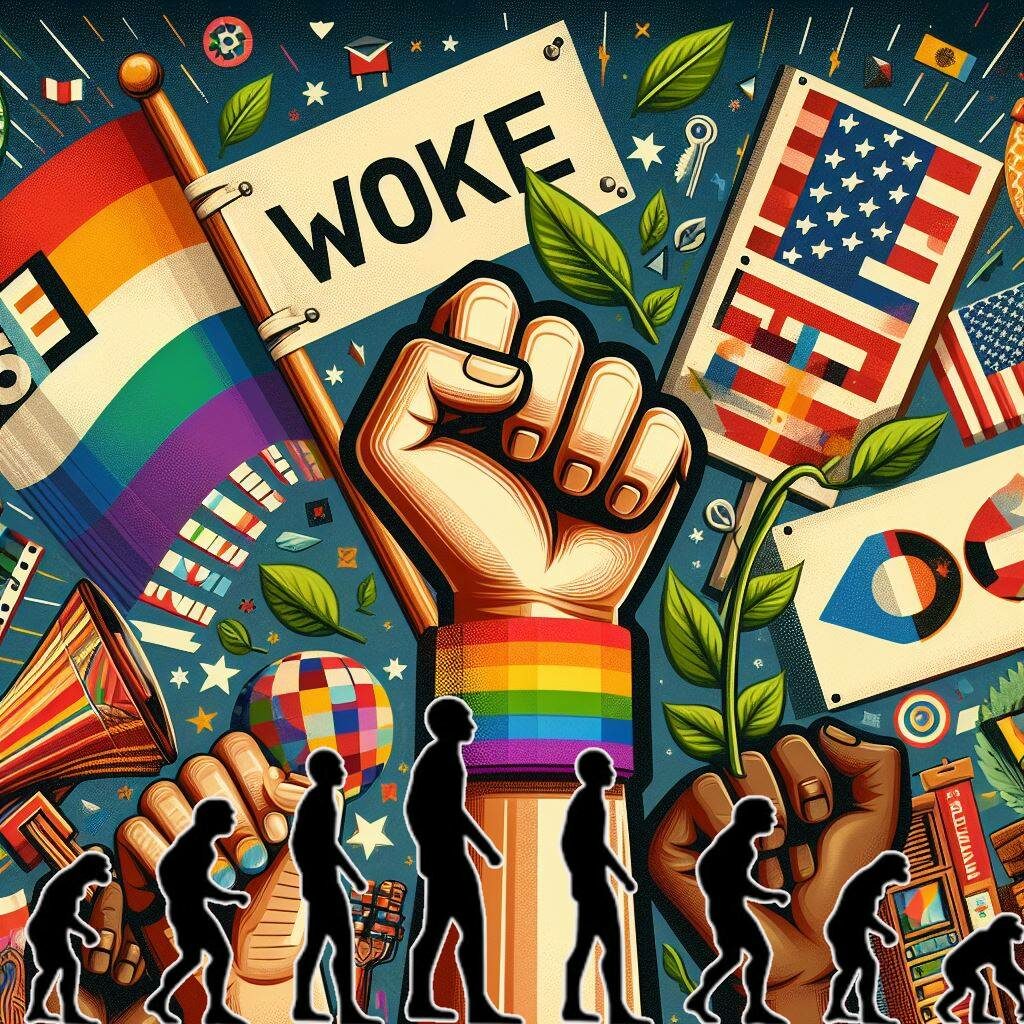
The ideological battles of the 21st century are driving the United States and Europe down divergent paths. In the U.S., Wokeism—a secular ideology with deep roots in the country’s religious past—has emerged as a powerful cultural force. While it shares many characteristics with America’s Great Awakenings, Wokeism has transformed into a movement centered on identity politics and systemic oppression. This article examines how Wokeism is a secularized version of the Great Awakenings and explores the unique challenges the U.S. faces in managing this ideological shift. Meanwhile, Europe, with its rising Muslim population and the possibility of a Christian resurgence, presents a different context in which religious pluralism might offer more ideological balance.
To understand Wokeism’s rise, we must trace its development within America’s religious history. We must also examine the decline of Christianity in the U.S., and explore the factors contributing to the U.S.’s vulnerability to this secular movement. However, it’s essential to avoid oversimplifying the cultural and political realities of both America and Europe. Instead, we must consider the complexity of these societies and the variety of outcomes that could emerge.
The Great Awakenings: America’s Christian Legacy
The Great Awakenings were transformative periods of religious revival in American history, shaping the country’s moral and political fabric. These movements inspired renewed religious devotion and fostered a culture of moral activism that continues to influence American society.
The First Great Awakening (1730s–1740s) arose in response to growing secularism and moral decline in colonial America. Evangelical ministers emphasized personal salvation and a direct relationship with God. This revival democratized religion, encouraging individuals to seek spiritual truth independently of established religious hierarchies. In doing so, it planted the seeds for the later intertwining of faith and moral activism in American culture.
The Second Great Awakening (1790s–1840s) expanded on these themes, intertwining Christian activism with social reform movements such as abolitionism and temperance. This period fostered the belief that America had a divine mission to reform society, embedding moral zeal and a sense of national purpose into the country’s identity.
The Third Great Awakening (late 1850s–early 1900s) saw the rise of the Social Gospel, a movement that sought to address modern social problems like poverty and labor conditions through Christian ethics. This emphasis on societal reform solidified moral activism as a core feature of American life.
These awakenings helped form a distinct American moral culture, one in which religious revivalism was not only about personal salvation but also about reshaping society. This legacy of moral activism would later resurface in both religious and secular social movements.
The Decline of Christianity and the Moral Vacuum
Despite the strong influence of Christianity through the Great Awakenings, the 20th century witnessed a steady decline in Christian authority in American public life. Several factors contributed to this decline, creating a moral vacuum that Wokeism eventually filled.
Secularism and scientific rationalism challenged the metaphysical claims of Christianity. As scientific explanations gained prominence, religious explanations became less central to public discourse. By the mid-20th century, secularism had become a dominant force in intellectual and cultural life, marginalizing religious perspectives.
The cultural upheavals of the 1960s, including the civil rights movement and the sexual revolution, further eroded Christianity’s authority. These movements, while morally driven, often opposed traditional Christian teachings on gender, sexuality, and family. The growing emphasis on individual autonomy weakened institutional Christianity’s ability to guide public morality.
The separation of church and state also contributed to Christianity’s decline in the public sphere. While guaranteeing religious freedom, this separation gradually pushed Christian moral frameworks out of public institutions, allowing secular ideologies to shape discussions of justice, ethics, and morality.
Additionally, postmodernism in academia questioned the existence of universal truths, arguing that knowledge is socially constructed and subjective. This intellectual shift further undermined Christianity’s claim to universal moral principles.
As Christianity’s influence waned, the desire for moral certainty and societal reform did not disappear. Instead, it was redirected into secular movements like Wokeism, which inherited the moral fervor of America’s religious past but stripped it of its theological foundation.
Wokeism as the Fourth Great Awakening: A Secularized Heresy
Wokeism can be understood as a secularized version of the Great Awakenings. Like its religious predecessors, Wokeism is concerned with moral absolutes, societal reform, and collective redemption. However, unlike earlier awakenings, Wokeism has replaced traditional Christian theology with secular beliefs centered around identity politics and systemic oppression.
In this way, Wokeism borrows heavily from the moral structure of Christianity while rejecting its theological foundation. Instead of original sin, Wokeism focuses on systemic sins such as racism, sexism, and privilege. Redemption is no longer achieved through Christ but through public activism and confessions of privilege. The rituals of Wokeism—public apologies, diversity training, and privilege-checking—serve as secular sacraments offering temporary absolution for the sins of oppression.
However, unlike its religious forebears, Wokeism is rooted in postmodernism, which rejects objective truth in favor of relativism. In the Woke worldview, morality is subjective and based on lived experiences, particularly those of marginalized groups. This rejection of universal moral principles enables Wokeism to operate without a need for a transcendent foundation, while maintaining the moral urgency that characterized earlier religious revivals.
Although Wokeism functions as a quasi-religious movement, it’s important to acknowledge that it is one of many social movements in the U.S. It operates within a broader cultural context that includes numerous ideologies, some of which challenge or coexist with Wokeism’s moral framework.
Defining Wokeism: A Secular Religion of Identity and Power
Wokeism views society as structured by systemic inequalities rooted in identity categories such as race, gender, sexuality, and class. It posits that individuals, based on their identity, are either complicit in maintaining systems of oppression or are victims of them.
Unlike earlier religious revivals, which focused on individual responsibility for sin, Wokeism emphasizes collective guilt based on group identity. For example, white people, men, and heterosexuals are seen as inherently privileged and complicit in systemic oppression. Guilt in this framework is inherited by virtue of identity rather than individual actions.
Redemption in Wokeism is achieved through moral activism, where individuals acknowledge their privilege and advocate for social justice. Public apologies, corporate diversity initiatives, and educational programs serve as paths to redemption in this moral framework.
Wokeism also rejects objective truth, embracing a relativistic view of morality and knowledge. In this worldview, the experiences of marginalized groups are regarded as the highest form of truth, immune to critique. This contrasts sharply with Christian universalism, which holds that moral truths are accessible to all through divine revelation.
While Wokeism has become a dominant moral framework in many American institutions, it operates alongside other ideologies and is subject to challenges from diverse sectors of society. It is not inevitable that Wokeism will continue to dominate or that it will have only negative outcomes. The trajectory of its influence depends on numerous political, social, and cultural factors.
The Fragmentation of America: Two Competing Moral Visions
As Wokeism has gained prominence, the United States has become increasingly divided between two moral visions. One vision adheres to traditional American values, celebrating the country’s founding principles, its emphasis on individual liberty, and its Christian heritage. This America sees the Constitution as a guiding document that upholds personal freedoms and limits government intervention.
The other vision, influenced by Wokeism, views the nation’s history and founding documents through the lens of systemic oppression. For Woke America, historical narratives must be reinterpreted to reveal the roles of patriarchy, white supremacy, and exploitation. This perspective challenges the country’s traditional heroes and reexamines symbols of national pride.
However, it’s important to recognize that these moral visions do not exist in isolation or as absolutes. Many Americans hold views that fall between these extremes, navigating the complex cultural landscape with a mix of traditional and progressive beliefs. The U.S. is not necessarily doomed to fragmentation, but it does face serious challenges in reconciling these competing moral frameworks.
Europe’s Future: The Rise of Islam and Religious Pluralism
While the U.S. grapples with the rise of Wokeism, Europe is facing a different ideological challenge: the rise of Islam. As Muslim populations in Europe continue to grow, Islam may become the largest devout religious group in some countries. This presents both challenges and opportunities for Europe, which is also contending with its own forms of cultural and political polarization.
Unlike Wokeism, Islam is rooted in a coherent metaphysical framework that provides a system of moral absolutes. This could make Islam a stabilizing force in Europe, as it offers an alternative to the relativism of secular ideologies. However, Islam’s growth in Europe also raises questions about how it will integrate with Western values such as individual rights, political pluralism, and freedom of expression.
At the same time, the rise of Islam could prompt a resurgence of Christianity in Europe. Faced with the growing influence of Islam, secular Europeans may turn back to their Christian roots as a source of cultural and spiritual cohesion. This could result in a pluralistic religious landscape where both Islam and Christianity offer moral frameworks that resist the dominance of secular ideologies like Wokeism.
It is crucial to acknowledge, however, that Europe’s future is complex and uncertain. The integration of Islam, potential Christian revival, and the challenges of secularism create a multifaceted cultural landscape. While Europe may be better positioned to resist Wokeism’s influence than the U.S., it still faces significant internal challenges.
Conclusion
The futures of the U.S. and Europe are diverging in important ways. In the U.S., Wokeism has emerged as a powerful secular movement that fills the moral vacuum left by Christianity’s decline. However, its emphasis on collective guilt, identity-based morality, and rejection of objective truth has created cultural and political divides that threaten to destabilize the nation. Yet, it is not inevitable that Wokeism will fracture the U.S.; many other cultural forces remain at play, and the outcomes will depend on how these forces interact in the coming decades.
Europe, by contrast, faces its own ideological challenges. The rise of Islam and the potential resurgence of Christianity could provide a more balanced ideological landscape, helping Europe navigate the complexities of modernity without succumbing to Wokeism’s dominance.
 jerusalemandathens.com